


Robot-Assisted Cardiac Surgery at University Hospitals Harrington Heart & Vascular Institute Provides Equivalent Outcomes with Shorter Patient Recovery
May 21, 2026

Innovations in Cardiovascular Medicine & Surgery | June 2026
University Hospitals Harrington Heart & Vascular Institute’s robotic cardiac surgery program continues to expand, earning a place as a regional leader in providing patients in Northeast Ohio with the least invasive surgical options while maintaining high-quality outcomes.
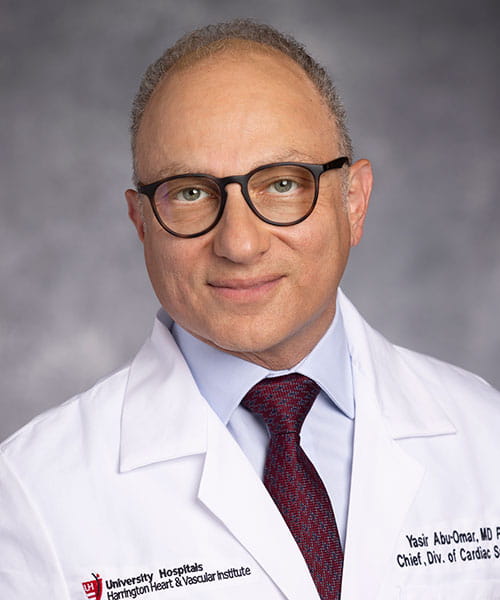 Yasir Abu-Omar, MD, PhD
“We built a minimally invasive program, and naturally it evolved into a robotic-assisted program,” says Yasir Abu-Omar, MD, PhD, Division Chief of Cardiac Surgery and the Russ and Connie Lincoln Chair in Cardiovascular Innovation at UH Harrington Heart & Vascular Institute, and Professor of Surgery, Case Western Reserve University School of Medicine. “But it’s crucial to recognize that this is not just the surgeon. It’s the environment, it's the multidisciplinary team of advanced practice providers, nurses, cardiologists and cardiac surgeons. Through everyone’s efforts, we can offer patients a mixture of approaches that serve them very well. We can provide the equivalent of what an open-heart operation would be offering by using less invasive approaches.”
The coronary team at UH Harrington Heart & Vascular Institute is one of the few in the world to perform totally endoscopic coronary artery bypass (TECAB) and was the first in the region to offer it to patients. During this procedure, an expert surgeon guides the surgical robot through a series of small incisions to access and harvest the left internal mammary artery (LIMA) inside the chest wall, then joining it to the left anterior descending artery through an anastomosis to complete the bypass.
The team also has a large and growing robotic-assisted program in minimally invasive direct coronary artery bypass (MIDCAB), another "keyhole" heart surgery that also avoids dividing the sternum. TECAB and MIDCAB are best for selected patients, Dr. Abu-Omar says, such as those with single or double vessel disease. For those with more extensive coronary artery disease, treatment may be “hybrid,” combining MIDCAB or TECAB with placement of a stent by an interventional cardiologist in one or more of the other affected arteries.
“Instead of having an open operation, which is quite invasive, they can end up having this robotic approach, hybrid, along with stenting,” Dr. Abu-Omar says. “They're usually done separately, in two different sessions, but for the patient, it affords them to have this minimally invasive approach.”
Minimally invasive robotic-assisted valve surgeries are also becoming increasingly common within UH Harrington Heart & Vascular Institute, Dr. Abu-Omar says. The team, for example, was the first in the region to offer robotic-assisted aortic valve surgery.
“Mitral valve repair is the most frequently performed robotic valve procedure, but the aortic valve is an area that is now expanding,” he says. “We have done several here, but not many centers in the world are doing those, because they tend to be somewhat more difficult.”
Dr. Abu-Omar highlights the reduced recovery time from robotic valve surgery made possible by a less invasive approach. Instead of a sternotomy that takes several weeks to heal, surgeons use a small incision with robotic assistance to guide a path to the heart through the ribs.
“We use a camera and robotic arms to go through these micro incisions,” Dr. Abu-Omar says. “Where we control it from a console, and we can achieve the same repair. Of course, we still have to use a heart-lung machine, we still have to stop the heart to be able to do the procedure, but then we do this by placing the patient on the heart-lung machine through a tiny incision in the groin.”
Hybrid procedures that treat atrial fibrillation also can be optimized with the surgical robot, Dr. Abu-Omar says. In addition to catheter ablation performed by electrophysiologists, cardiac surgeons can use the robot as a tool to treat atrial fibrillation and reduce the risk of stroke from the left atrial appendage. The UH Harrington Heart & Vascular Institute team was also the first in the region to offer this procedure, under the leadership of Gregory Rushing, MD. Dr. Rushing and colleagues work together as one of the only teams in the world to perform combined cases of robotic assisted CABG and atrial fibrillation ablation, giving patients with both diseases ideal treatment while still providing a minimally invasive approach.
“Using specially designed surgical clips, we can advance them and close that appendage to avoid clots forming in the outpouching of the left atrium, which can result in stroke,” he says.
Dr. Abu-Omar says he’s enthusiastic about what robotic-assisted surgery means, both for the team of surgeons and more importantly for the cardiac surgery patients.
“You need appropriate training and expertise in doing this,” he says. “But the visualization that you can get with the robot is second to none. It's unbelievable. You can literally get that visualization well inside the heart. Having done mitral valve procedures for many years, routine utilization of the robot has transformed my practice.”
“We can make this less invasive, with less surgical trauma and drive much quicker recovery for the patients, with a superior cosmetic result without compromising the overall outcome,” he adds. “With incentives of excellence, appropriate expertise and the multidisciplinary team approach, we can potentially achieve better results with robotic cardiac surgery than with open procedures.”
The team of robotic surgeons at University Hospitals Harrington Heart & Vascular Institute is now represented by Yasir Abu-Omar, MD, PhD, Gregory Rushing, MD, Mohamed Abdel Halim, MD, PhD and Joseph Sabik, III, MD, Chairman of Surgery.
Contributing Expert: Yasir Abu-Omar, MD, PhD