

From Clinical Trials to Commercial Use, University Hospitals Harrington Heart & Vascular Institute Provides Renal Denervation for Treatment-Resistant Hypertension
October 13, 2026
Innovations in Cardiovascular Medicine & Surgery | October 2026
Interventional cardiologists at University Hospitals Harrington Heart & Vascular Institute offer renal denervation, a minimally invasive adjunctive treatment for patients whose hypertension remains inadequately controlled despite lifestyle modification and medical therapy.
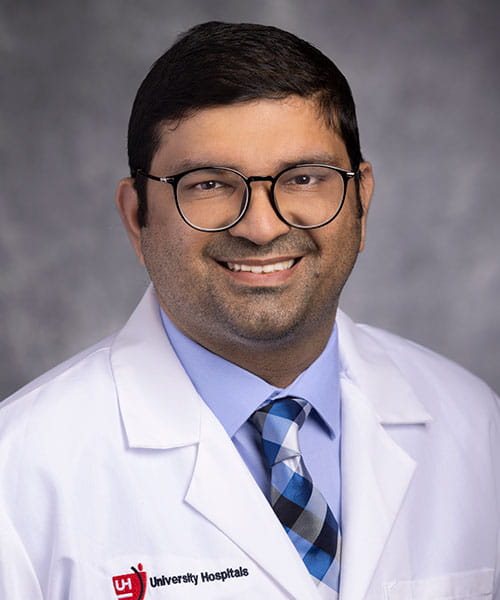 Sundeep Kumar, MD, FACC
The U.S. Food and Drug Administration (FDA) approved two catheter-based renal denervation systems in 2023, following multicenter randomized clinical trials demonstrating meaningful and durable reductions in blood pressure with favorable safety profiles.
“University Hospitals was an early participant in the renal denervation clinical trials and has remained actively involved as renal denervation has evolved from an investigational technique to clinical practice,” says Sundeep Kumar, MD, FACC, an interventional and endovascular cardiologist at University Hospitals Harrington Heart & Vascular Institute. “That experience has allowed us to develop the expertise to bring this therapy to patients across our health system, with outcomes that have been consistent with the efficacy and safety demonstrated in clinical trials.”
The Medtronic SPYRAL program evaluated catheter-based radiofrequency ablation of sympathetic nerves surrounding the renal arteries as a means of lowering blood pressure. In 2023, the FDA also approved the Paradise™ Ultrasound Renal Denervation System, developed by Recor Medical, which uses circumferential ultrasound energy delivered through a balloon catheter to disrupt sympathetic nerve activity surrounding the renal arteries.
A Third Pillar for the Treatment of Hypertension
“High blood pressure is one of the leading contributors to cardiovascular disease and mortality, yet historically our treatment options have centered on lifestyle modification and medications,” Dr. Kumar says. “Renal denervation gives us a third pillar of treatment to use alongside those established approaches and expands what we can offer patients whose blood pressure remains difficult to control.”
University Hospitals initially offered renal denervation at UH Cleveland Medical Center and is now expanding access across the health system. This summer, Dr. Kumar and the interventional cardiology team performed the first renal denervation procedure at University Hospitals Portage Medical Center, bringing the therapy closer to patients throughout Northeast Ohio.
Patient selection is central to the program. Dr. Kumar and the interventional cardiology team work closely with cardiologists, primary care physicians and nephrologists across University Hospitals to identify appropriate candidates, exclude secondary causes of hypertension and evaluate potential procedural contraindications.
“The procedure itself is relatively straightforward, but the most important part is selecting the right patient and working collaboratively with the physicians who manage that patient’s hypertension,” Dr. Kumar says. “We see this same model across cardiovascular medicine: when we consider a procedure such as WATCHMAN implantation, for example, the proceduralist works closely with the referring cardiologist or electrophysiologist to determine whether it is the right option for the individual patient.”
This collaborative model also forms the foundation for a broader goal at University Hospitals: development of a comprehensive, multidisciplinary hypertension program. “We are bringing together the different specialists involved in hypertension care rather than approaching it as simply a procedure,” Dr. Kumar says. “Our goal is to build a comprehensive program that integrates medical management, evaluation for secondary hypertension and advanced therapies such as renal denervation. We are actively developing that program now and expect to have it established soon.”
Looking Ahead: Intervening Earlier
As the program grows, Dr. Kumar is also focused on reaching patients earlier in the course of hypertension. “Too often, the patients referred to us are older, taking six or seven medications, or have already experienced a major cardiovascular event such as a heart attack or stroke,” he says. “We should not have to wait until hypertension has caused irreversible damage. When blood pressure remains elevated, we need to identify those patients earlier and intervene before they develop cardiovascular, kidney or cerebrovascular complications.”
Clinical research will remain another important component of the program. “Our participation in pivotal clinical trials positioned University Hospitals Harrington Heart & Vascular Institute to be an early adopter as renal denervation moved into clinical practice,” Dr. Kumar says. “We are building on that experience by continuing to participate in studies that advance our understanding of hypertension, expand treatment options and ultimately improve outcomes for our patients.”
For more information on renal denervation or to refer a patient, contact Dr. Kumar at Sundeep.Kumar@UHhospitals.org.
Contributing Expert: Sundeep Kumar, MD, FACC