


A Lifelong Commitment to Children with Type 1 Diabetes
August 17, 2026
From the moment she stood in front of her fourth-grade class in Middlebury, Vermont, delivering a book report about women who could “do anything,” Jamie Wood, MD began picturing her future.
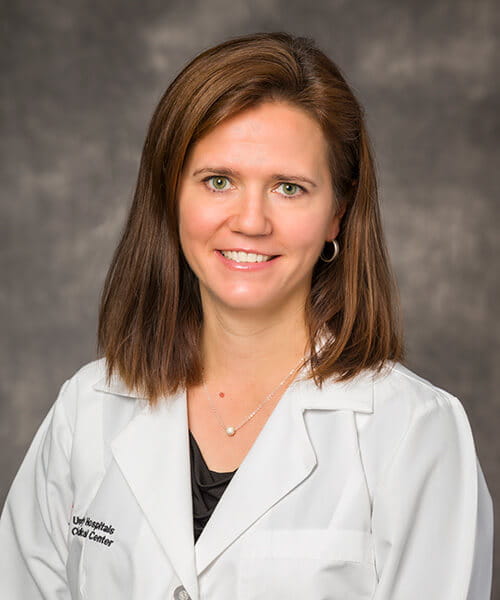 Jamie Wood, MD
She announced that she’d decided she would become a pediatrician. A couple of decades later, she did.
That early declaration evolved into a career that is defined by empathy, innovation and a deep commitment to children living with Type 1 diabetes.
Dr. Wood had been raised in a family devoted to care and service. Her father was a large-animal veterinarian who tended to dairy cows across rural Vermont, and her mother, an early childhood educator, ran a pioneering childcare program for at‑risk young women — many of them teens — just across the street from the local high school.
The program paired childcare with education and work requirements, so that the young parents could build skills to move their lives forward.
Another early spark came when in grade school, the students were assigned to interview members of the community. Dr. Wood chose one of the area’s first female physicians, and realized it might be possible for her to become a physician too.
Dr. Wood went to Cornell University in Ithaca, New York, where her early interest in medicine solidified. She didn’t have any physicians in her family, but she definitely had role models — most significantly Dr. Wayne Peters. He was her pediatrician for more than two decades, beginning right after her birth. “Doc Pete” was beloved and celebrated by Middlebury residents for his kindness and dedication. The New York Times even covered an appreciation party the town threw for him.
He shaped Dr. Wood’s understanding of medicine, but also of Type 1 diabetes, which he lived with himself. “That left a lasting impression on me,” she says, and eventually led to her clinical path.
Discovering Pediatric Endocrinology
After Cornell, she went to the University of Vermont Medical School. At the time, she expected to pursue general pediatrics. A key mentor, Dr. Johana Brakeley — now retired — helped shape her early clinical training and curiosity. Then, during a fourth-year medical school rotation in pediatric endocrinology, she felt what she calls “the initial bug” for the field. Still, her plan was to complete residency and return to Vermont to join her longtime pediatrician’s practice.
But during her residency, Dr. Peters passed away at 68, in part from diabetes complications. It was a pivotal moment that had Dr. Wood thinking about how she could honor his influence.
Another formative experience also had a deep impact. Between her first and second years of residency, Dr. Wood spent a week volunteering at Camp Ho Mita Koda in Newbury Township, which is the world’s longest‑running diabetes camp, founded in 1929 and the first of its kind. There, children as young as 5 come for a week to experience a “normal” summer camp, supported by medical professionals who manage the intensive demands of Type 1 diabetes behind the scenes.
“The kids are amazing — brave, resilient, and joyful,” she says. “People don’t always realize what it takes to manage Type 1 diabetes around the clock, especially for young children. Camp shows them and their families that they can do hard things and still have fun.”
That week proved decisive. Pediatric endocrinology, she realized, offered the chance to combine long-term relationships, high-impact science, family education and advocacy — often beginning at diagnosis and continuing into adulthood.
Training at a Leading Children’s Hospital
Dr. Wood completed her pediatric residency and first year of a pediatric endocrine fellowship at University Hospitals Rainbow Babies & Children’s, while her husband pursued a PhD at Case Western Reserve University. When his postdoctoral work took him to Harvard, the family relocated briefly to Boston. Even then, Dr. Wood focused her pediatric residency search on top pediatric programs nationally, particularly in the Midwest, where her husband’s family lived.
UH Rainbow Babies & Children’s stood out. It was ranked among the nation’s top pediatric institutions, so ultimately became her first choice. She still keeps a handwritten note from Dr. Michael Dell, a UH Rainbow pediatrician at the time and now Vice Chair for Education, that she received after her interview. She also interviewed with Dr. William Dahms, a pediatric endocrinologist who would later become an important influence in her career.
Advancing Care Through Technology and Teamwork
Today, Dr. Wood is at the forefront of pediatric Type 1 diabetes care — an area that has seen remarkably rapid advancement during her career. When she was in medical school, fast‑acting insulin analogs were just emerging. During her fellowship, basal insulin therapy became standard. Continuous glucose monitors (CGMs) were not yet widely available when she began practicing.
Now, she helps lead care in an era of hybrid and automated insulin delivery systems — technology that pairs insulin pumps with CGMs to adjust insulin in real time. These systems can prevent dangerous blood sugar lows, reduce prolonged highs and significantly lessen the daily burden on patients and their families.
“We now measure success not just by hemoglobin A1C, but by time in range — how much of the day a child’s glucose stays between 70 and 180,” she explains. “These tools help us keep kids in that range more consistently, which supports better long-term outcomes and gives kids more freedom to participate in sports and everyday activities.”
Despite these advances, she is candid with families about the realities of Type 1 diabetes. The disease still demands constant attention with management challenges and a psychosocial burden.
Yet she is optimistic.
“When I meet a newly diagnosed family, I tell them we now have the tools to optimize management in ways we couldn’t before,” she says. “My hope is that children diagnosed today will live full lives with a normal life expectancy. It’s still hard work, but the trajectory is changing and their future is bright.”
Dr. Wood remains deeply engaged in research and collaboration, regularly participating in clinical trials and technology studies with colleagues such as Sarah MacLeish, DO. She recently returned from an international conference in Barcelona focused on stem‑cell–derived islet cell replacement and immune modulation — approaches that could transform prevention and treatment over the next decade.
One immediate milestone has already arrived. UH Rainbow Babies & Children’s is the first program in Northeast Ohio to offer teplizumab (TZIELD), an FDA‑approved monoclonal antibody therapy that can delay the onset of Type 1 diabetes by a median of two years in high‑risk children when given before clinical diagnosis. Approved for patients age 1 and older, the therapy represents a major shift — from managing disease to delaying its progression.
In collaboration with adult endocrinology colleagues, including Natalie Bellini, DNP, Dr. Wood has helped screen and treat the program’s first patients, including an 8-year-old child.
“We’re finally intervening before diabetes fully develops,” she says. “That’s incredibly meaningful for families and for the future of this field.”
A Field Defined by Hope
Dr. Wood credits much of her success to teamwork. UH now offers a robust, coordinated transition from pediatric to adult care, supported by leaders such as Dr. Betul Hatipoglu, who expanded Type 1 diabetes expertise on the adult side, and Dr. Erika Lundgrin and colleagues across UH locations — from main campus to community clinics throughout Northeast Ohio.
For Dr. Wood, pediatric endocrinology remains both intellectually exhilarating and deeply personal.
“It’s a fun field because it never stands still,” she says. “I’ve watched the science move faster than I ever imagined — and with it, the possibilities for children and families.
“That’s what keeps me inspired.”
Congratulations to Dr. Wood on her recent “Dinner with the Doc” honor from UH CEO Cliff A. Megerian, MD, FACS, Jane and Henry Meyer Chief Executive Officer Distinguished Chair. To nominate a physician for this honor, please use this nomination form.
For Dr. Wood, whose life’s work is dedicated to children with Type 1 diabetes, late spring brought an enormous professional achievement: The FDA approved Afrezza, a brand-name insulin, for kids 6 and older with diabetes.
The drug has been on the market for adults for more than a decade, but it is the first needle-free option for pediatric patients with Type 1 or Type 2 diabetes.
Dr. Wood — an endocrinologist and medical director of pediatric diabetes at UH Rainbow Babies and Children’s Hospital — was a lead investigator in the clinical trial.
We demonstrated in the trial that when you compare inhaled insulin to injected insulin, the results are about the same,” Dr. Wood said. “We also showed through 52 weeks of pulmonary function testing that function remained stable, with no safety signals.”
Afrezza can cost more than $2,000 a month, but its manufacturer, MannKind, says most people pay $35 or less through Medicare caps or reduced commercial insurance costs. For cash-paying patients, the drug is available for $99 a month, a company spokesperson said.
Afrezza is dosed through a special inhaler, with color-coded cartridges based on three dosing options. Dr. Wood says that many pediatric patients will continue to choose insulin pumps, while others may prefer injections or inhaled insulin depending on their individual circumstances.
Patients or parents interested in the option should talk with their child’s endocrinologist to determine what may be right for them.