


UH Rainbow Adopts Novel Rotational Guided Growth Technique for Correcting Femoral Version and Tibial Torsion
July 07, 2026
Innovations in Pediatrics | Summer 2026
 Raymond Liu, MD
 James Voos, MD
Orthopaedic surgeons at University Hospitals Rainbow Babies & Children’s Hospital are offering rotational guided growth (RGG) — a novel technique to correct pathologic femoral version and tibial torsion in appropriate pediatric patients.
Pathological rotational deformities of the lower extremities are usually asymptomatic, but in some cases cause children and adolescents to experience activity-related pain, altered gait mechanics and joint instability, which can worsen as they naturally become heavier and more active.
“These are highly prevalent conditions we have been treating in kids for a long time,” says Raymond Liu, MD, an orthopaedic surgeon and the Victor M. Goldberg Endowed Chair in Orthopaedics at University Hospitals and Professor at Case Western Reserve University School of Medicine. “Historically, most patients with these rotational abnormalities progress well with physical therapy, but others have required a complex osteotomy and an extended recovery. Rotational guided growth is a relatively new, lower-morbidity alternative that uses an oblique tension-band plate across each side of the physis to gradually correct torsional deformities as children’s bones develop.”
Surgeons place screw-and-cable tether constructs spanning the medial and lateral aspects of the growth plate, oriented at 90 degrees on the lateral view. Following treatment, the ideal outcome is for patients to achieve rotational correction, while preserving equal limb lengths and neutral mechanical axes, without destruction of any part of the physis or major surgery.
Early results suggest that RGG corrects rotational deformity in both the femur and tibia. However, precise timing and surgical technique are required to avoid under- or overcorrection. Treatment typically lasts one to two years, with patients’ rotational growth meticulously monitored with examination and X-ray imaging. Currently, Dr. Liu follows up with patients every three months.
“Although we have made some exceptions, patients should have at least two years of growth remaining to be considered candidates for this procedure,” he says. “We have been performing rotational guided growth surgery since the start of 2024, and one of our key biomechanical findings is that the correction is not linear — meaning the rate of change is slower at the beginning of treatment and faster at the end.”
Continually Advancing Femoral Version and Tibial Torsion Treatment
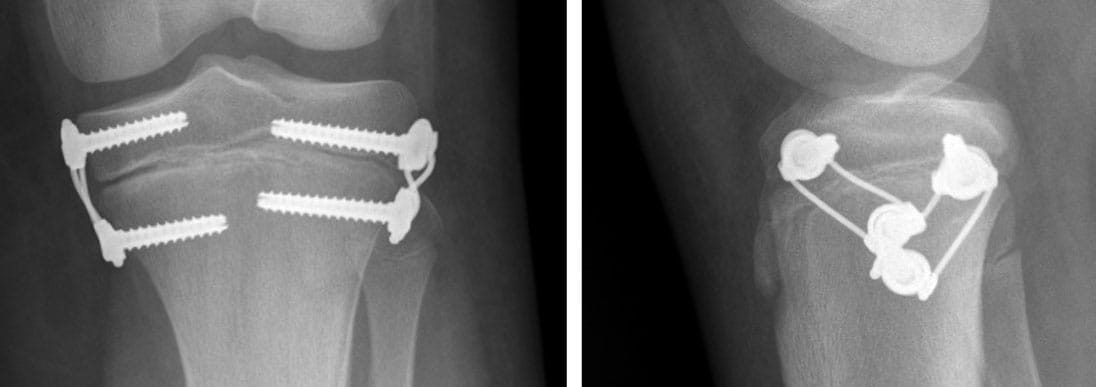 Figure 1: This 9 year old girl presented with symptomatic external tibial torsion in combination with other deformities and was treated with rotational guided growth as a portion of her care. The implants are oblique to the growth plate on the lateral view.
In conjunction with performing RGG surgeries, Dr. Liu and his colleagues are using imaging measurements to study their patients’ outcomes and pediatric bone growth. They are preparing to publish their findings.
“We are seeing a lot of interest in rotational guided growth because I think this technique may mark a sea change in orthopaedics,” Dr. Liu says. “It is exciting when we can offer patients an effective treatment that is associated with less pain, shorter immobilization, lower costs and reduced surgical risk.”
One additional benefit is that the correction is gradual, allowing the muscles to slowly adapt to the new bone position rather than abruptly with osteotomy surgery.
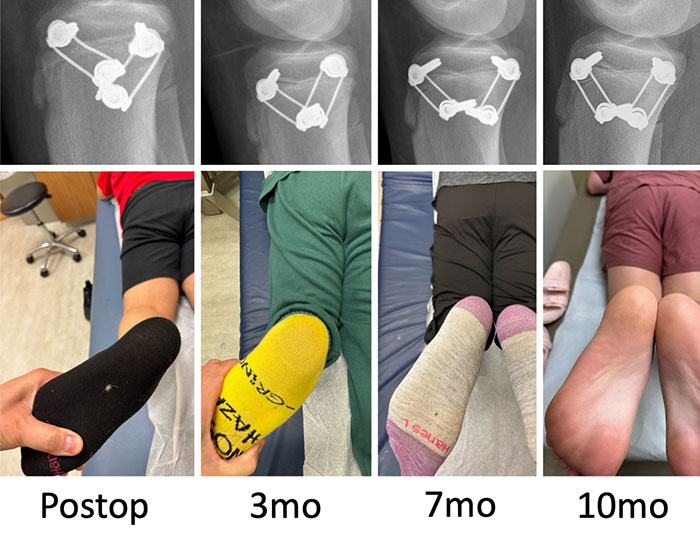 Figure 2: In the same patient, these radiographs show how angle between the implants converge as the child grows. The corresponding clinical photos for each xray show how the angle between the thigh and the foot gradually improves with this process, with the position nearly normal at 10 months after surgery.
This past May, Dr. Liu presented a study on femoral version and tibial torsion during natural growth at the Pediatric Orthopaedic Society of North America’s annual meeting in Orlando.
“We used CT scans to better understand what is happening anatomically in children and adolescents who are developing normally and to help determine when the bones settle and stop changing,” Dr. Liu says. “Understanding normal development is important to guide when interventions should occur.”
Nationally Recognized Pediatric Orthopaedic Care
Consistently ranked among the nation’s leading orthopaedic programs by U.S. News & World Report, UH Rainbow Babies & Children’s Hospital is committed to providing the best musculoskeletal care with a focus on continued growth and development.
“Our experts at Rainbow are able to treat problems ranging from the simplest to the most challenging,” says James Voos, MD, Chair of the Department of Orthopaedic Surgery at University Hospitals, the Jack and Mary Herrick Distinguished Chair in Orthopaedics and Sports Medicine at University Hospitals, Executive Director of the UH Haslam Sports Innovation Center, and the Charles H. Herndon Professor and Chair at Case Western Reserve University School of Medicine. “When a child comes through our doors, families have a level of trust that they will meet the right person and receive the right level of care.”
For more information, contact Dr. Liu at Raymond.Liu@UHhospitals.org.
Contributing Experts: Raymond Liu, MD and James Voos, MD