


University Hospitals Offers Comprehensive Hair Restoration Procedures to Restore Natural-Looking Hair and Improve Patient Confidence
August 18, 2026

Innovations in Ear, Nose & Throat | Summer 2026
University Hospitals Cleveland Medical Center offers comprehensive medical and surgical hair growth management for men and women, featuring personalized solutions to enhance hair health, appearance and patient confidence. Services include platelet-rich plasma (PRP), platelet-rich fibrin (PRF), surgical hair transplantation and forehead contouring. The team also addresses beard and eyebrow concerns and hair loss from burns, scarring or traumatic injury.
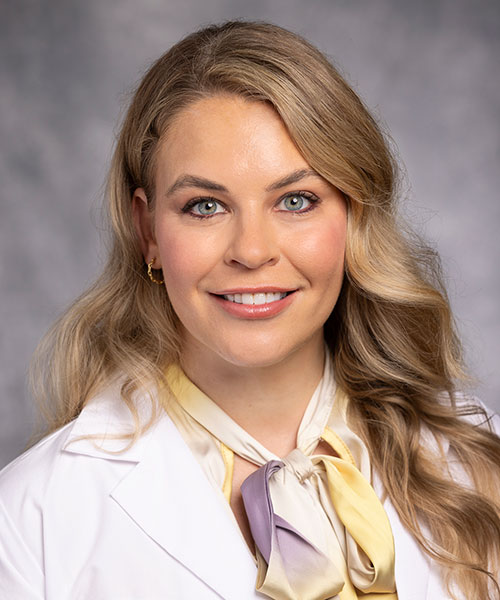 Amanda Goslawski, MD
“I think the multidisciplinary approach we take to help patients with hair restoration sets University Hospitals apart as an academic medical center,” says Amanda Goslawski, MD, a Facial Plastic Surgeon within the UH Department of Otolaryngology — Head and Neck Surgery and an Assistant Professor at Case Western Reserve University School of Medicine.
Dr. Goslawski often sees patients referred to her by dermatology and collaborates with specialists in endocrinology, rheumatology and gynecology to help identify underlying causes of hair loss and develop comprehensive treatment plans.
A graduate of Loyola University Chicago’s Stritch School of Medicine, she completed her residency in Otolaryngology-Head and Neck Surgery at University Hospitals in 2024. She returned to Cleveland in 2025 after completing a facial plastic surgery fellowship at Boston Medical Center, where she trained under Jeffrey Spiegel, MD, the esteemed facial plastic surgeon who pioneered the field of gender affirming facial plastic surgery and cosmetic facial surgery.
“My fellowship training was centered on cosmetic facial plastic surgery and gender affirming care and how hair restoration pertains to this field,” Dr. Goslawski says. “People would come to us for forehead contouring and scalp advancement surgeries that not many health systems offer.”
When seeing patients in clinic, Dr. Goslawski takes a thorough medical history and orders labs to help determine if there is a biochemical cause for hair loss. If there are no improvements after three to six months of standard treatment with topical or oral medications such as Minoxidil or dihydrotestosterone blockers, more advanced procedures are considered.
PRP and PRF
Both PRP and PRF are natural, autologous blood-derived therapies used to support orthopedic healing, skin rejuvenation and hair restoration.
“Blood plasma contains growth factors that support tissue remodeling and collagen production that we administer using microfollicular techniques,” Dr. Goslawski says. “While PRP provides an immediate release of growth factors, PRF is spun at lower speeds to retain more stem and white blood cells that form a natural fibrin scaffold that traps those growth factors and increases platelet count to provide longer-lasting results.”
She explains that PRP has a peak growth factor rate on the day of injection and can last for about seven days, whereas PRF has a peak release on day seven and is absorbed for up to three weeks.
After allowing a numbing cream to take effect, Dr. Goslawski will administer PRP or PRF using a fine-gauge needle. “The number of injections will depend on where the patient is experiencing hair loss, but the average is 15 to 20 sites,” she says. “If hair loss is at the vertex or back of the crown, there are fewer injections than if we are treating temporal recessions or decreased hairline density.”
Treatments do require maintenance. Dr. Goslawski recommends patients start with a series of three appointments.
“We want to target the hair at all stages of growth, so we will do three monthly injections because that is the growth cycle of the scalp,” she says. “At six months, we can evaluate results because the hair will have had time to respond to the introduction of PRP or PRF.”
Afterward, she recommends patients return annually to maintain results.
Hair Transplantation
Dr. Goslawski also offers surgical hair transplantation, including hairline reshaping, treatment of male-pattern baldness and increasing density to help patients achieve fuller, natural-looking hair. She also performs eyebrow and beard transplants and coverage for traumatic burns or scars.
Hair grafts are typically taken from the occipital area. “Wherever you take it from, hair retains its identity,” Dr. Goslawski says. “Hair from the back of the head tends to be resistant to hormone fluctuations, so it makes a very effective graft.” She will often combine surgical transplantation with PRF to help stimulate follicle growth over time.
The right treatment option depends on the individual goals of each patient. “Anecdotally, I see more men opting for hair transplantation and more women choosing PRP or PRF because of the nature of hair loss,” Dr. Goslawski says. “Male-pattern hair loss tends to be more localized, but women experience more of a diffuse loss pattern, so candidacy is an important treatment consideration.”
Patient Age is Trending Downward
Individuals seek hair restoration treatment for varied and highly personal reasons, including hereditary pattern baldness, hormonal shifts (including pregnancy and menopause), nutrient deficiencies, gender transitioning, rapid weight loss, autoimmune disease, alopecia, stress and traumatic injury. Dr. Goslawski has noticed that patients are seeking hair regrowth or transplant care at younger ages.
“With more people working remotely and seeing themselves on camera or social media, they are more cognizant of their hair,” she says. “I do think there has been a huge push in self-care and pursuing treatment that will boost people’s confidence.”
Contributing Expert: Amanda Goslawski, MD