


Former Hospitalist Uses Novel Position in Anesthesiology to Coordinate Care for Complex Surgical Patients
June 23, 2026
UH Clinical Update | June 2026
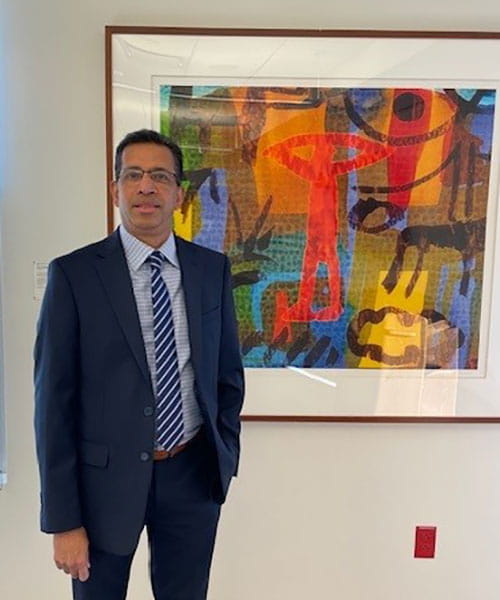 Vasu Sidagam, MD
Eight years into his career as a hospitalist at University Hospitals, Vasu Sidagam, MD, wanted to try something different. So Rajesh Chandra, MD, head of the Hospitalist Division at UH Cleveland Medical Center, suggested fellowship training in Perioperative Medicine at UH Cleveland Medical Center under the leadership of James Rowbottom, MD, then-Chairman of Department of Anesthesiology & Perioperative Medicine. The goal? To serve the increasing number of complex surgery patients being treated at the UH quaternary care center.
“We were getting patients with multiple medical conditions, who were all complicated,” Dr. Sidagam says. “Take, for example, a 70-year-old patient with heart failure, who has a defibrillator, a prior history of blood clots and DVTs and is also on a couple liters of oxygen but now needs major cancer surgery. Understanding the medical, surgical and anesthesia issues is crucial. My Perioperative Medicine fellowship involved exposure to all these areas and more, not only intraoperatively but also how patients recover and what happens to the medical complexity as they're recovering from the stress of anesthesia and surgery.”
At the end of his fellowship, Dr. Sidagam was offered a position in the UH Department of Anesthesiology, where he is the only hospitalist with focused practice in perioperative care assessing patients preoperatively for urgent/time-sensitive surgeries and continuing management of their medical conditions postoperatively as well. Though most internal medicine hospitalists across the country take care of postoperative patients in some measure, very few are embedded in Anesthesiology Departments as full-time faculty and even fewer who focus exclusively in Perioperative Medicine.
“In the U.S., there are very few perioperative medicine fellowships offering training in what I do specifically, bridging training in the three areas of surgery, anesthesiology and internal medicine,” Dr. Sidagam says. “I'm definitely not an anesthesiologist. I don't put patients to sleep in the operating room. I'm definitely not a surgeon. I'm not the one operating. But understanding medical comorbidities and how those things change in the context of surgical stress and anesthesia -- and then taking care of all these medical conditions as the patients recover from anesthesia and surgery -- that’s what I've been doing.”
And his impact is already being felt.
“Dr. Sidagam's impact on the success of patient care at University Hospital has been profound,” says Karen Margolin, RN. “Through his clinical excellence, collaborative spirit and unwavering commitment to doing what is right, he has helped elevate the standard of care and strengthen the hospital’s mission of teaching, healing and compassion. Dr. Sidagam fosters an environment where all caregivers collaborate as a cohesive team, united in the shared goal of providing exceptional patient care and continuously improving outcomes.”
Karen also points out Dr. Sidagam’s talents as a teacher and mentor.
“He takes great pride in guiding nurses, interns and residents,” she says. “He willingly shares his knowledge and clinical expertise, offering thoughtful instruction and encouragement that help shape the next generation of healthcare professionals. His calm, supportive approach makes learning both meaningful and inspiring.”
UH CEO Cliff A. Megerian, MD, FACS, Jane and Henry Meyer Chief Executive Officer Distinguished Chair, recently recognized Dr. Sidagam with a “Dinner with the Doc” honor.
Dr. Sidagam says a position like his only works through trust and collaboration.
“My colleagues in anesthesia and surgery have been instrumental in helping me talk through these complicated patients and educating me as I educated myself in taking care of these patients,” he says. “Over the last 10 years, I've come to know many surgeons in different surgical subspecialities on a more one-to-one basis so that I could put in context the medical comorbidities the patient came in with. That type of cross-bridging knowledge of anesthesia and surgery helped me be a better clinician and better team member as I take care of these patients. These insightful discussions have educated me enormously. I am deeply appreciative of my colleagues in anesthesia and surgery for their collaborative spirit and trusting me to care for their patients.”
In communicating with patients who have complex medical problems, Dr. Sidagam says he takes great care to slowly and thoroughly go over the chart and every step that will happen with the surgery – preoperatively, intraoperatively and postoperatively.
“When I bring up those areas of information, they feel reassured,” he says. “They also feel reassured that somebody who understands their medical condition is communicating with the anesthesiologist on the morning of the procedure. Often they see me coming to the pre-op area and then they see me after surgery on the surgical floor, interacting with the surgical team. It’s a continuous continuum of care and being a part of the team. That reassures the patient when they see a consistent face.”
Congratulations to Dr. Sidagam on his “Dinner with the Doc” honor.
To nominate a physician for this honor, download the Cliff Appreciates Nomination Form. The next deadline is August 7.