


Inside The NFL Blue Medical Tent
February 25, 2026
Innovations in Orthopaedics | Spring 2026
In Week 5 of the 2025 NFL season, the Cleveland Browns hosted the Minnesota Vikings in London at Tottenham Hotspur Stadium. The matchup was the most-watched NFL Network London game on record.
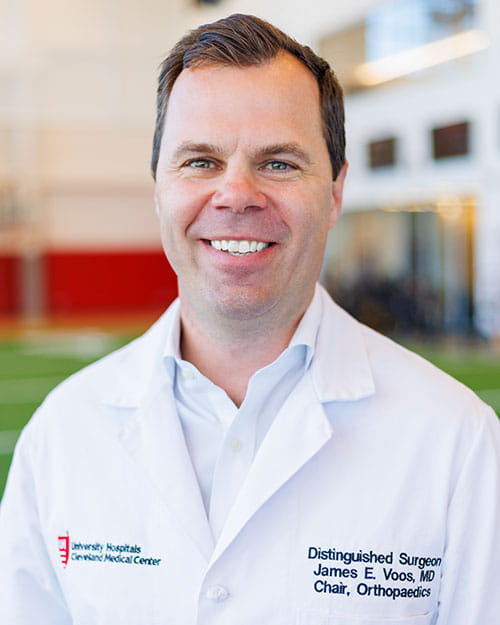 James Voos, MD
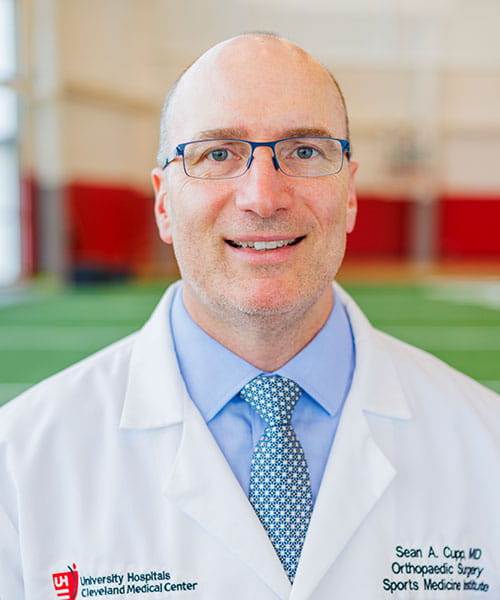 Sean Cupp, MD
Prior to kickoff, BBC Sport interviewed James Voos, MD, Head Team Physician for the Cleveland Browns and President of the NFL Physicians Society (NFLPS), for a behind-the-scenes look at the NFL’s blue medical tent and the extraordinary coordination of experts and resources that keep players safe on game day. Introduced in 2017, the league-mandated tent unfurls on the sidelines to enable rapid assessment of on-field injuries.
“The blue tent is an incredible example of how we provide these elite athletes with the highest level of care, helping us perform a more precise player evaluation immediately after injury,” says Dr. Voos, Chair of the Department of Orthopaedic Surgery at University Hospitals, the Jack and Mary Herrick Distinguished Chair in Orthopaedics and Sports Medicine at University Hospitals, Executive Director of the UH Haslam Sports Innovation Center. “It replaces practicing medicine in front of millions of people watching the game with a true physician-patient relationship by reducing stadium distractions and providing a sense of privacy.”
Sean Cupp, MD, Lead Medical Physician for the Cleveland Browns and Co-Director of the UH Drusinsky Sports Medicine Institute, assesses head and torso injuries to determine whether individuals can safely return to play. Dr. Cupp primarily uses the blue tent for concussion evaluation. “These players are athletes and sports entertainers, but they are also individuals who have the same rights to medical privacy as everyone else in the stadium,” he says. “This gives us an area of protection where we can do our job relatively close to the field without spending time walking to the locker room.”
NFL Safety Protocols
Whether at home or on the road, a full medical team is assembled before each game, including:
- Two orthopaedic surgeons
- Two sports medicine doctors
- An emergency response physician
- Athletic trainers on the field
- Two unaffiliated neuro consultant spotters monitoring the game from the stadium booth to identify potential player injuries, especially concussions and head and neck trauma
“One of the initiatives we wanted to complete during my term as President of the NFL Physician Society is to standardize all of our health and safety measures,” says Dr. Voos. During the preseason, every team prepares an emergency action plan, gathering the entire medical team to repeatedly rehearse scenarios such as a severe lower extremity fracture, head injury or cardiac arrest.
An hour before kickoff, medical specialists, stadium personnel, referees and local emergency responders gather to review the detailed emergency action plan. “The end goal of everyone practicing is that no matter what stadium or environment we are in, we know that players can receive the same high level of care,” says Dr. Voos. “Particularly now that the NFL is playing more international games, the level of expected safety remains absolutely consistent, so players can focus on the game.”
For example, the league has worked to refine procedures to reduce concussion incidence. “The concussion protocol that has been agreed upon by the NFL and the NFL Players’ Association has worked very well,” says Dr. Cupp. “We have the numbers to show that the diagnosis of concussion has decreased with the steps we are taking, including rule changes, spotters and evaluations for return to play.”
Caring for the Hometown Team
Dr. Voos, Dr. Cupp and the entire UH Drusinsky Sports Medicine Institute are committed to providing NFL-level care to athletes of all ages across Northeast Ohio. “We are applying what we have instituted with the Cleveland Browns at the youth, high school and college levels to create a safe environment for those games,” says Dr. Voos.
From local high school teams adopting the blue tent to regional athletic conferences implementing pregame medical meetings, University Hospitals experts are on the sidelines overseeing player safety. “Our exceptional providers and athletic training staff take care of over 70 high schools, providing care to student athletes and addressing the concerns of patients and their parents,” says Dr. Cupp.
Each Friday night during the fall sports season, the UH After the Lights walk-in clinic is open to provide timely evaluations of on-field injuries. Additionally, the expansion of the Cleveland Browns’ 16-acre training facility will further extend University Hospitals’ sports medicine and orthopaedic care to Berea and surrounding communities, including student athletes at Baldwin Wallace College.
The world of sports is increasingly prioritizing injury prevention and adopting appropriate safety initiatives. “I think people want to see significant competition but also know that athletes at all levels will be able to live long and healthy lives,” says Dr. Voos. “At University Hospitals, we are staying true to our commitment to take care of athletes from Pee Wee to pro.”
For more information, contact the UH Drusinsky Sports Medicine Institute at 440-940-4417.
Contributing Experts:
James Voos, MD
Chair, Department of Orthopaedic Surgery
Executive Director
University Hospitals Haslam Sports Innovation Center
Jack and Mary Herrick Distinguished Chair, Orthopaedics and Sports Medicine
University Hospitals Cleveland Medical Center
Charles H. Herndon Professor
Case Western Reserve University School of Medicine
Head Team Physician, Cleveland Browns
Medical Director, Cleveland Ballet
Sean Cupp, MD
Co-Director, University Hospitals Drusinsky Sports Medicine Institute
University Hospitals Cleveland Medical Center
Assistant Professor
Case Western Reserve University School of Medicine
Lead Medical Physician, Cleveland Browns