


Cardiovascular and Radiation-Oncology Teams at University Hospitals Join to Launch New Noninvasive Treatment for Ventricular Tachycardia
December 28, 2025

Innovations in Cardiovascular Medicine & Surgery | January 2026
Experts from University Hospitals (UH) Harrington Heart & Vascular Institute are joining forces with their radiation oncology colleagues at UH Seidman Cancer Center to offer a rapid, noninvasive treatment option for patients with refractory ventricular tachycardia (VT). The new treatment could slash treatment time by almost 90%.
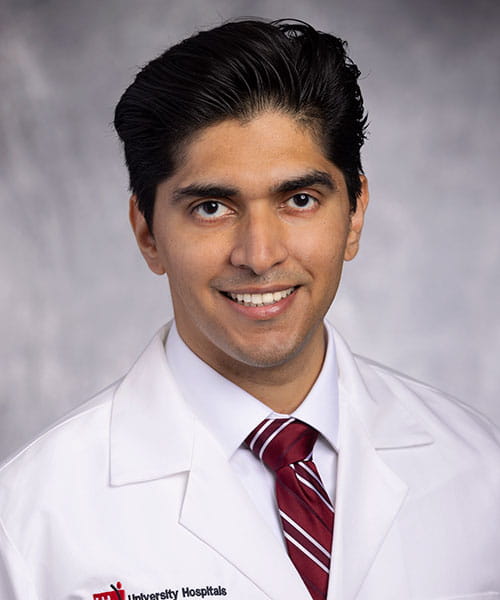 Esseim Sharma, MD
Better treatment options are sorely needed for this often-lethal condition, the UH team says. Most VT patients have an implantable cardioverter defibrillator (ICD), which can sometimes lead them to experience post-traumatic stress disorder (PTSD) when it activates multiple times, among other complications.
“We've come to realize that repeated shocks not only are bad for patients in terms of overall mortality, but they also lead to a lot of downstream effects, including PTSD, significant discomfort and morbidity,” says Esseim Sharma, MD, a cardiac electrophysiologist and Director of Ventricular Arrhythmias Research at UH Harrington Heart & Vascular Institute.
Ablation is a way to reduce ventricular tachycardia, but it, too, has drawbacks.
“Those procedures can be very long, taking anywhere from four to six hours,” Dr. Sharma says. “Some patients with advanced cardiac disease may be too frail, have blood clots in their heart or have had ablations that have failed, making them unsuitable for catheter ablation.”
The new option – launching at University Hospitals Cleveland Medical Center and available at very few other centers globally – is stereotactic body radiation therapy (SBRT) for VT, which can be completed noninvasively in about 40 minutes.
“Radiation therapy for ventricular tachycardia offers a noninvasive option to improve the patient’s quality of life -- an option that would not have been available to them otherwise,” Dr. Sharma says. “It brings a lot of patients who may not be candidates for catheter ablation to become candidates for treatment.”
With this new offering, advanced cardiac imaging is essential, including AI-generated models of the areas in the heart that are the source of arrhythmia. And cross-disciplinary collaboration is vital.
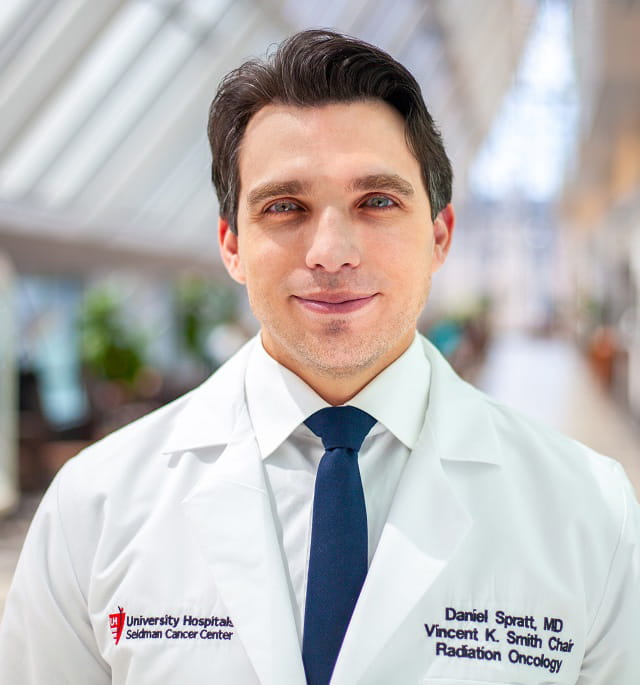 Daniel Spratt, MD
“Radiation oncology plays a foundational role in this,” says Daniel Spratt, MD, Chair of Radiation Oncology at UH Seidman Cancer Center and Vincent K. Smith Chair in Radiation Oncology. “It is a multidisciplinary approach. It takes a lot of precision and collaboration between cardiology, radiation oncology and our medical physics team to help us to target exactly the area that's going to be treated.”
Rojano Kashani, PhD, is the Vice Chair and Director of Physics and Dosimetry at UH Seidman Cancer Center. She was involved in the initial work to propel this technology for use in VT patients.
“Identification of the target is complex, which is done through the collaboration between the radiation oncology and cardiology team,” she says. “With all of the technology and AI-assisted tools we have, we're able to make it extremely accurate with incredible precision.”
Dr. Sharma adds that SBRT also offers clear procedural advantages when ablating the tissue causing VT. Areas deep inside the heart can be difficult to reach with a catheter, he says. Some areas may be blocked by blood clots.
“The beauty of radiation is that we can get into these areas and actually destroy that tissue without ever having to put in a catheter,” he says.
SBRT for VT is currently approved by the FDA for compassionate use only and is available at UH only for patients who are not candidates for traditional catheter ablation, or those who’ve had previous unsuccessful attempts at traditional catheter ablation. However, studies investigating more widespread use are ongoing.
“As we gain experience in this field as an initial treatment for patients, this could become an option,” Dr. Sharma says. “Perhaps this will become a routine part of our armament in terms of treating ventricular tachycardia.”
The UH team says they’re eager to help propel this innovation forward.
“It's really decades in the making of serial advancements that have enabled something like this,” Dr. Spratt says. “Having the experts in cardiology looking outside of their normal toolbox is going to enable UH patients to have all treatment options available to them and receive the best possible outcomes.”
Contributing Experts:
Esseim Sharma, MD
Director, Ventricular Arrythmias Research
University Hospitals Harrington Heart & Vascular Institute
Assistant Professor of Medicine
Case Western Reserve University School of Medicine
Daniel Spratt, MD
Chair, Radiation Oncology
Vincent K. Smith Chair in Radiation Oncology
University Hospitals Seidman Cancer Center
Professor of Radiation Oncology
Case Western Reserve University School of Medicine
Vice Chair and Director of Physics and Dosimetry
University Hospitals Seidman Cancer Center
Associate Professor of Radiation Oncology
Case Western Reserve University School of Medicine