


First Gene Therapy Approved for Rare Congenital Hearing Loss
August 19, 2026

Innovatoins in Ear, Nose & Throat | Summer 2026
This spring, the U.S. Food and Drug Administration (FDA) granted accelerated approval to Otarmeni™ from Regeneron Pharmaceuticals, marking the first gene therapy approved to treat severe-to-profound hearing loss caused by a mutation in the otoferlin (OTOF) gene.
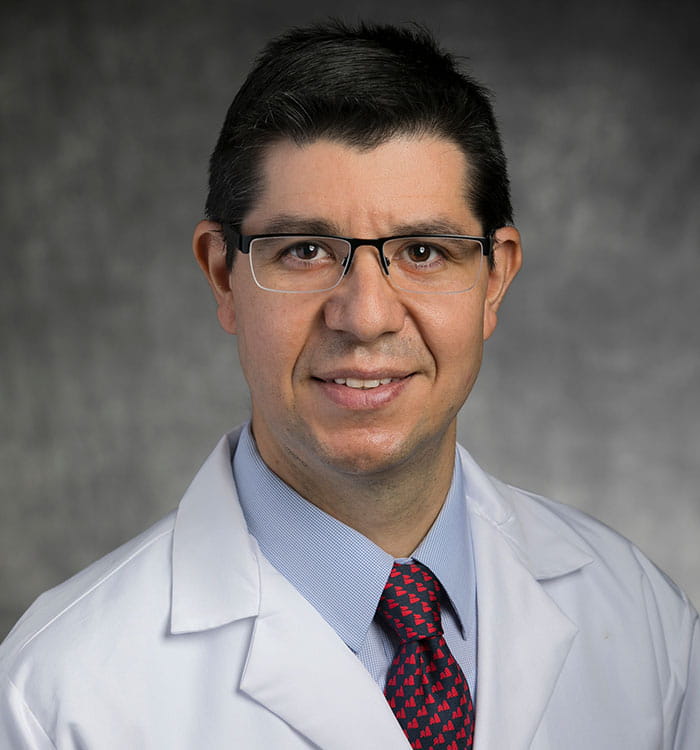 Alejandro Rivas, MD
“While otoferlin mutations are very rare, this treatment is the first of its kind to receive FDA approval, opening an exciting frontier in gene therapy to restore hearing in patients with genetic hearing loss,” says Alejandro Rivas, MD, Director of the Cochlear Implant Program, University Hospitals Ear, Nose & Throat Institute and the Richard W. and Patricia R. Pogue Chair in Auditory Surgery and Hearing Sciences at University Hospitals, and Professor of Otolaryngology and Neurological Surgery at Case Western Reserve University School of Medicine. “Many genes have been identified as contributors to hearing loss at birth, and there are many potential genetic therapies in the pipeline that will hopefully become available in the next decade, including research conducted here at University Hospitals and Case Western Reserve University on Usher Syndrome Type 3A, led by Dr. Kumar Alagramam.”
Understanding the OTOF Gene and Treatment
In total, genetic mutations account for 50 to 60 percent of congenital hearing loss.
 Cameron Wick, MD
“The OTOF genetic defect is autosomal recessive, meaning both parents have normal hearing, but their children have a 25 percent chance of inheriting both defective genes and being deaf,” says Cameron Wick, MD, an Otologist/Neurotologist at the University Hospitals Ear, Nose & Throat Institute and an Associate Professor at the School of Medicine. “This genetic problem, also referred to as DFNB9, accounts for one percent of congenital deafness and is associated with a group of problems that cause auditory neuropathy spectrum disorder and poor inner hair cell function.”
Otarmeni delivers a functional copy of the OTOF gene to inner hair cells to restore otoferlin production and auditory signaling. The drug and administration kit are combined into a biologic-device product that is administered as a single dose per ear, surgically delivered into the cochlea via a syringe and catheter connected to an infusion pump.
“OTOF brings calcium into the inner hair cell, triggering the release of an excitatory neurotransmitter that stimulates the auditory nerve — without otoferlin, the hair cells cannot ‘talk’ to the auditory nerve,” Dr. Wick says. “Drug delivery to the cochlea is challenging, which makes this therapy groundbreaking because it provides proof of concept that gene therapy can work in the inner ear.”
Although sample sizes are small and longitudinal monitoring is needed, the success rate for Otarmeni treatment has been high. Of 12 patients, 75 percent had their hearing restored to normal or near-normal levels and will likely not need a hearing aid. However, early intervention remains crucial for all individuals born with hearing loss.
“In children born with bilateral nerve hearing loss, there is a time limit for restoring truly functional hearing,” Dr. Rivas says. “If there is a delay, the brain network can be populated by other types of neurons, and you lose the opportunity to form pathways for understanding sound.”
He adds that the ideal time for hearing restoration is in the first year of life, although good results have been documented in children up to age two.
University Hospitals offers genetic testing and counseling to help identify genes that may be targets for future treatments. “We recommend genetic testing for any patient under 40 so that when new gene therapies become available, we can identify individuals who might benefit,” Dr. Rivas says. “Currently, for genetic hearing loss not caused by an otoferlin mutation, cochlear implants remain the standard of care.”
Cochlear Implant Center of Excellence+
The UH Cochlear Implant Program is celebrating 30 years of providing patients with the gift of hearing. One of the largest and most esteemed centers for cochlear implantation worldwide, the program ranks among the top 10 in the nation for total number of cochlear implants performed.
The center’s expert team of surgeons, neurotologists, audiologists, speech-language pathologists and genetic counselors offers patients coordinated, multidisciplinary hearing care. “Whatever treatment route patients choose,” Dr. Rivas says, “our highly qualified team has extensive expertise in helping patients throughout the journey, from preplanning and surgery to fine-tuning speech and hearing postoperatively, to achieve phenomenal results.”
Usher Syndrome Type 3A
 Kumar Alagramam, PhD
Usher Syndrome Type 3A (USH3A) is a rare genetic disorder characterized by progressive hearing and vision loss.
“Patients with a mutation in the Clarin-1 gene do not produce the normal Clarin-1 protein, which is essential for the mechanosensory ‘hair’ cells in the inner ear,” says Kumar Alagramam, PhD, Director of Research and the Anthony J. Maniglia Chair for Research and Education at the UH Ear, Nose & Throat Institute and a Professor at the School of Medicine.
Dr. Alagramam and his team employed an AAV-mediated gene augmentation approach to deliver a functional copy of the Clarin-1 gene to the cochlea in a mouse model of progressive hearing loss in USH3A, achieving sustained hearing preservation. “In 2017, we published a very specific therapeutic DNA sequence that, when delivered perinatally, provides durable preservation of hearing and prevents deafness in a USH3A mouse model,” he says.
In 2019, Akouos, a Boston-based gene therapy company (a subsidiary of Eli Lilly & Co. since Dec. 2022), exclusively licensed the gene therapy sequence jointly owned by University Hospitals and Case Western Reserve University. The company is in the preclinical development phase as it works to bring the treatment to market.
“This is an exciting time to play a role in enabling discoveries that are advancing the field of hearing restoration,” Dr. Alagramam says. “The research collaboration we have at University Hospitals and Case Western Reserve University is moving these therapies from the lab to the USH3A patients. We still have a way to go, but the possibility is real.”
Contributing Experts: Alejandro Rivas, MD | Cameron Wick, MD | Kumar Alagramam, PhD