


What You Need to Know About Kratom
June 29, 2026
UH Clinical Update | June 2026
Do you have a patient using kratom? Or do you suspect it? The herbal substance derived from the leaves of the Mitrogyna speciosa tree, found in gas stations, smoke shops and specialized online vendors, is becoming increasingly popular. The 2023 National Survey on Drug Use & Health estimates that there are 1.6 million annual users in the U.S. – and that’s not good news.
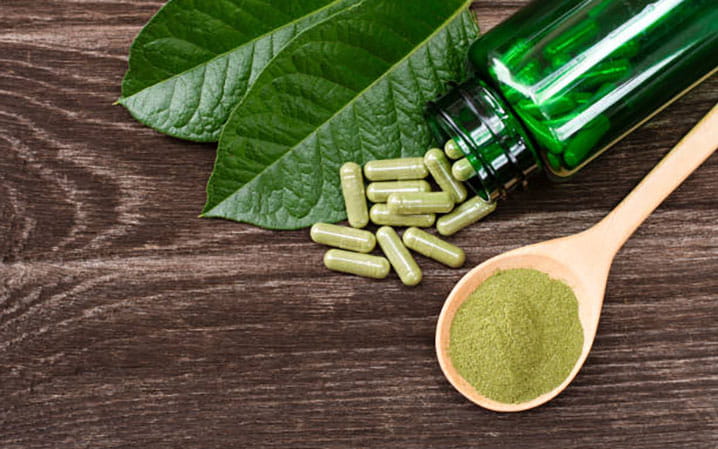
Kratom is sold either fresh or dried, with dried kratom leaves commonly sold in powder form and converted to capsules, tablets, gum and other edible products. And while users seek it out for its mild stimulant effects or opioid‐like analgesic and sedative effects, in higher doses, kratom can result in harmful side effects, experts say. These include nausea and vomiting, agitation, confusion, high blood pressure, rapid heart rate, seizures and respiratory depression, according to the National Institute on Drug Abuse.
UH pharmacist Sam Stitzel, PharmD, Manager of Clinical Education and UH Program Lead for Project DAWN, explains the mechanism of action – and the risks.
”Kratom’s two primary alkaloids are mitragynine and 7-hydroxymitragynine (7-OH), which produce similar psychoactive effects to opioids,” he says. “Research shows that compared to morphine, 7-OH-mitragynine has about 13 times the affinity for opioid receptors. 7-OH-mitragynine has about 46 times the affinity for opioid receptors compared to mitragynine.”
“Kratom also has many significant and potentially dangerous drug interactions with other substances, specifically with central nervous system (CNS) depressants including opioids, benzodiazepines, alcohol, sleep aids, muscle relaxants, antidepressants and antipsychotics,” he adds. “If kratom is used with other CNS depressants, fatal respiratory depression, overdose or CNS depression can occur.”
To compound the danger, kratom is not regulated by the U.S. Food and Drug Administration, putting people at risk of consuming products that may contain additives or inaccurate dosages, increasing the potential for adverse effects safety concerns and fatal overdoses.
How Best to Manage Patients Taking Kratom
Stitzel and Jeanne Lackamp, MD, DFAPA, FACLP, Chair of Department of Psychiatry, Psychiatrist in Chief for University Hospitals and Director of the Behavioral Health Institute, offer this guidance for best practices in clinical care for patients who use kratom:
- Include kratom assessment for the patient in a way that feels consistent with the non-judgmental and routine nature of a competent medical or mental health evaluation.
- Embed questions about the use of herbal medicines “like Valerian root or kratom," in an assessment of medications and supplements, to acknowledge kratom's place among other treatments that people choose to use. This stance is non-stigmatizing and may increase the likelihood of honest patient disclosure.
- Initiate a discussion with open-ended questions about patients' experiences with kratom, desired outcomes and concerns. This enables practitioners to assess gaps in knowledge or false beliefs and identify areas for education.
- Seek to understand a patient's motivations for use, and then provide education around other evidence-based treatments such as cognitive-behavioral therapy for anxiety and buprenorphine for opioid use disorder.
- Explicitly state that you (the clinician) are unable to recommend or condone the use of kratom or any substance that is not approved by the FDA, but that you can provide education and work to understand patient's kratom use.
- Assist patients with kratom or 7-OH withdrawal, and possibly medications for opioid use disorder, particularly for those with a history of opioid use disorder.
- Provide patient-friendly, non-stigmatizing education to patients that the analgesic effects of mitragynine are reversible with the administration of naloxone.
Testing for Kratom
Monitoring and screening patients for kratom consumption can be very difficult, given that kratom does not typically appear on routine panel drug screens, Stitzel says. To detect kratom, a specialized panel must be ordered to test for the substance/metabolite. Quest Diagnostics offers a quantitative urine mitragynine drug test – a screening immunoassay confirmed by chromatography/mass spectrometry.
Stitzel says it’s important for UH providers and others to have increased awareness of the potential harm kratom can create.
“Since 2020, more than 20 people have died from kratom overdose in Cuyahoga County,” he says. “Most concerning is how easy it is to access by teens, who are still developing the skills and judgment to resist dangerous substances.”
And the problem isn’t going away.
“Although we in Ohio recently banned all synthethic forms of kratom from being sold in the state, it is still available for purchase in neighboring states and over the internet,” adds Dr. Lackamp. “Given that it can be so readily obtained, strategies to combat its use are crucial.”
For more information about substance use disorder treatment, please consult UH Addiction Recovery Services.