


UH Neurologist Works on Global Scale to Improve Stroke Outcomes
June 23, 2026
UH Clinical Update | June 2026
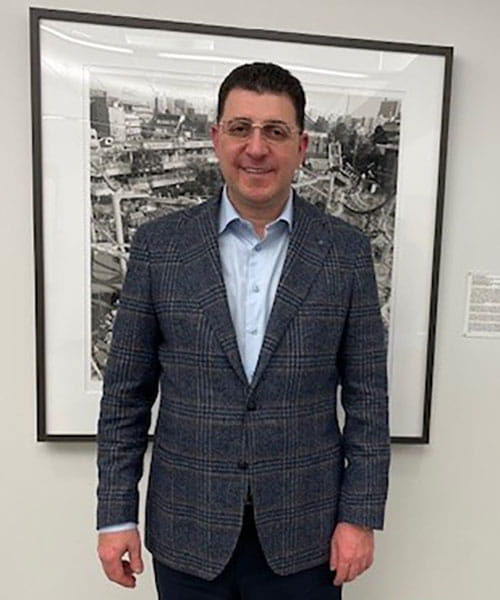 Amrou Sarraj, MD
For many decades, stroke medicine operated under a stark reality: time was the ultimate gatekeeper.
If too many hours had passed since onset, there was little physicians could do. Patients with severe or “large” strokes — especially those arriving late — were often steered toward long-term care, their futures defined by disability or silence.
Amrou Sarraj, MD, George M. Humphrey, II Chair in Neurology, has spent much of his career challenging that inevitability. Today, his work is reshaping how physicians treat stroke and who gets a second chance.
Dr. Sarraj is the kind of physician who thrives on urgency. “Our deepest satisfaction is always measured by the profound difference we make,” he says. In stroke care, critical decisions are often made in minutes and those decisions can be the difference between disability or recovery.
A vascular neurologist and researcher, he has built his career around one of medicine’s most time-sensitive crises: a blocked blood vessel in the brain that can rapidly steal a person’s ability to speak, move or think. While others saw an unforgiving clock, he saw an opportunity to rethink it.
Since joining University Hospitals in 2021, after 15 years at UTHealth Houston, Dr. Sarraj has led a systemwide effort to ensure stroke patients receive, as he says, “the right care at the right time at the right facility.” As Director of the Comprehensive Stroke Center at UH Cleveland Medical Center, and Director of Stroke Systems at the UH Neurological Institute, he has advanced the science and delivery of care.
At the center of that work is thrombectomy, a procedure that removes a clot from the brain. Once limited to a narrow treatment window, it was often unavailable to patients with larger strokes or those who arrived later.
Dr. Sarraj helped change that. As global principal investigator of the landmark SELECT2 trial, he led research on patients with large ischemic strokes — many of whom previously would not have been treated. The findings were striking: patients who received a thrombectomy alongside medical therapy, even up to 24 hours from symptoms, had dramatically better outcomes.
Published in The New England Journal of Medicine in February 2023, the results shifted global guidelines and earned him a Top Ten Clinical Research Achievement Award in 2024.
“We challenged that and found that patients can improve,” he says. “Forty percent of them eventually walked independently. This changed the guidelines and the way of thinking.”
That shift is both philosophical and clinical. Stroke care once focused primarily on how much time had passed. Dr. Sarraj’s work emphasizes what brain tissue can still be saved.
Advanced imaging now shows that hours or even days later, parts of the brain may remain salvageable. His ongoing research is exploring thrombectomy up to 72 hours after stroke onset, suggesting the window for meaningful intervention may be far wider than once believed.
“Some patients improve right away. Others take time. But you’re giving them a chance they didn’t have before,” he says.
That chance can mean the difference between lifelong disability and independence, between losing speech and regaining it.
Dr. Sarraj’s impact extends well beyond research.
He recognized that breakthroughs only matter if patients can access them, so he led the expansion of UH’s TeleStroke service line — transforming a phone-based consult model into a real-time audio-video network connecting stroke specialists with hospitals across the region. The service now spans UH community hospitals, Western Reserve Hospital, and multiple Aultman hospitals.
“The vast majority of hospitals in the U.S. do not have stroke specialists,” he says. “If you want to deliver state-of-the-art treatment everywhere, you have to have a system that allows the stroke specialists to deliver care remotely.”
This required coordinated efforts across emergency medicine, IT, nursing, hospitalists, and neurology teams, so UH has built a system that allows patients to remain in their communities when appropriate, while still accessing advanced care.
By expanding telemedicine, standardizing protocols and leading systemwide stroke care, Dr. Sarraj and his team are working to ensure that geography, timing, or a patient’s initial hospital no longer determine outcomes. “University Hospitals have a fantastic healthcare system providing care to Northeast Ohio. Our state-of-the-art TeleStroke network enables our stroke providers to ensure optimal care, regardless of wherever our patients present.”
Born in Syria and now a Professor of Neurology at Case Western Reserve University School of Medicine, he has built a career that bridges global research and local impact. His work leading international trials reflects both the scale of the challenge and the universality of its stakes.
Stroke remains a leading cause of death and disability. Yet in just over a decade, the field has transformed from the introduction of thrombectomy in 2015 to expanding treatment windows from 6 hours to 24, and now potentially to 72.
Dr. Sarraj has been a driving force in that evolution.
“A lot of times, we could do nothing,” he says. “Now, we can restore what was lost.”
Congratulations to Dr. Sarraj on his “Dinner with the Doc” honor from UH CEO Cliff A. Megerian, MD, FACS, Jane and Henry Meyer Chief Executive Officer Distinguished Chair.
To nominate a physician for this honor, download the Cliff Appreciates Nomination Form. The next deadline is August 7.