


Advancing Health Through Innovation and Research at UH
May 11, 2026

UH Research & Education Institute
Despite an increasingly competitive funding environment, University Hospitals (UH) continued to expand its research and innovation enterprise in 2025, delivering measurable benefits to patients and communities. UH achieved its strongest year to date, growing its research portfolio by 11 percent, from $214 million to $237 million.
This growth reflects more than scientific productivity. It demonstrates UH’s ability to translate discovery into clinical care, expanding therapeutic options, accelerating innovation, and improving outcomes, particularly for patients with limited or no existing treatments. UH’s integrated research continuum enables discoveries to move seamlessly from laboratory science to bedside care.
“We are about delivering hope to patients with no options,” said Daniel Simon, MD, President, Academic & External Affairs and Chief Scientific Officer, during his 2026 State of UH Research Address. “Our goal is to bring the next generation of drugs, devices, and therapies to people who are waiting for an option—or a cure.”
Strategic investments in infrastructure, interdisciplinary collaboration and diversified funding have strengthened UH’s research enterprise and accelerated innovation across the system. As a result, University Hospitals Cleveland Medical Center is now ranked No. 7 among the most reputable academic medical centers in the United States and No. 15 globally, according to Brand Finance.
In 2025, UH led Ohio with 3,590 active clinical research studies and reported 115 invention disclosures and 1,544 publications. UH also trained nearly 1,200 residents and fellows and provided over 2,100 medical student clerkships and rotations, cultivating the next generation of physicians, scientists, and clinical leaders.
Building High-Impact Research Programs
Sustained research investment has enabled UH to build high-impact programs that integrate clinical expertise, advanced technology, and long-standing academic partnerships to address unmet medical needs.
A flagship example is the UH Eye Image Analysis Reading Centers (EIARC), developed through a 30-year collaboration with Case Western Reserve University (CWRU). EIARC supports multicenter clinical trials and leads the development of advanced imaging technologies used globally. In 2025, the National Eye Institute expanded funding for the Diabetes Endothelial Keratoplasty Study (DEKS), reinforcing confidence in UH’s leadership in ophthalmologic research.
In parallel, UH has significantly strengthened health services and data-driven research capabilities through the UH Health Services Research Center (HSRC). Launched in 2024 and led by Samudragupta Bora, PhD, the center now manages a research portfolio exceeding $100 million. The HSRC focuses on improving care delivery, outcomes measurement, and the integration of data into clinical practice. Guided by Dr. Bora, UH was invited to participate in the NIH Data COUNTS™ initiative, contributing to the development of national standards for research metrics and innovative use of patient-reported outcomes.
Other sustained investments include the Division of Research Radiology, which has secured more than $50 million in active funding since 2021. Investigators in the division have advanced MRI fingerprinting technologies—initially developed for brain imaging—that are now being applied across kidney disease and multiple cancers.
Investing in Talent and Innovation
UH’s research growth is fueled by a sustained commitment to talent recruitment, retention, and early-stage discovery. Through its partnership with CWRU, the CWRU–UH Joint Strategic Leadership Committee (JSLC) has committed nearly $22 million through 2030 to recruit and retain leading investigators and launch new research programs. These investments have already resulted in new faculty hires, faculty retentions and expanded interdisciplinary collaboration.
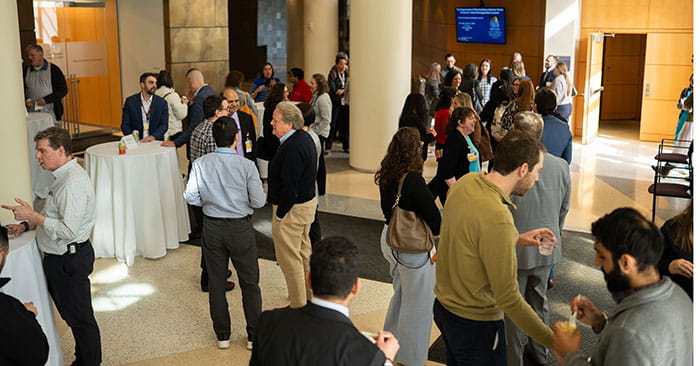 Faculty and staff at the reception following the 2026 UH State of Research program presented by UH Research & Education Institute.
The JSLC also supports innovation through Collaborative Science Pilot Awards, which funded five interdisciplinary projects in 2025. These early-stage investments are designed to generate preliminary data and position teams for competitive external funding.
At the regional level, UH continues to play a leading role in the JobsOhio Cleveland Innovation District. Investments totaling $17.5 million have supported commercialization through UH Ventures and accelerated discovery through the UH Harrington Discovery Institute, strengthening UH’s ability to translate science into patient-impacting therapies.
Supporting the Next Generation of Physician-Scientists
Developing early-career investigators remains a core priority for UH. In 2025, physicians James Ross, MD (surgery); Jared Travers, MD, PhD (Medicine); Bianca Islam, MD, PhD (Medicine); and Melissa Lumish, MD (Medicine) were selected for highly competitive K12 career development awards highlighting the national strength of UH’s physician-scientist pipeline.
Through the HSRC, UH also awarded Career Advancement Grants in 2025 to Joseph Kohne, MD, MSc (Pediatrics), and Molly McVoy, MD (Psychiatry). Additional internal pilot funding supported investigators including Qian Wang, MD, MPH; Faezeh Sodagari, MD; Richard Hoehn, MD; Kevin Makino, MD, PhD; Anna May, MD, MSc; and Christopher Towe, MD. Together, these programs reflect UH’s commitment to building a diverse, sustainable research workforce.
Translational Research Driving Discovery
Across UH laboratories, researchers are advancing discoveries that span neurodegeneration, cancer, metabolic disease, and immune-mediated conditions.
Kalyani Chaubey, PhD, working in the laboratory of Andrew Pieper, MD, PhD, demonstrated in preclinical models that restoring NAD+ metabolism can reverse Alzheimer’s disease pathology. In related work, Dr. Pieper and Sanford Markowitz, MD, PhD, identified 15-PGDH as a promising therapeutic target for tissue repair and neurodegenerative disease, earning the PNAS Cozzarelli Prize for scientific excellence.
Jonathan Stamler, MD, identified SCoR2 as a key regulator of fat metabolism, with preclinical studies showing that inhibiting the enzyme reduced obesity, fatty liver disease, and LDL cholesterol—findings that suggest new approaches to treating metabolic disorders.
Additional federally funded research in 2025 included work by Chen Zhao, MD, advancing therapies targeting leukemia stem cells; Stephen Carpenter, MD, PhD, studying immune responses to tuberculosis to inform vaccine development; Peter MacFarlane, PhD, and Richard Martin, MD, examining the effects of neonatal respiratory support on lung development; Wendi O’Neil, DDS, investigating HPV-related cancers; and Reshmi Parameswaran, PhD, developing CAR‑T cell therapies for osteosarcoma.
Advancing Clinical Care Through Innovation
UH clinicians are leading clinical innovations that directly affect patient care. Under the leadership of Betul Hatipoglu, MD, UH became the first site in Ohio to offer FDA-approved allogenic pancreatic islet cell therapy for patients with Type 1 diabetes, expanding options for patients with difficult-to-control disease.
Rebecca Flyckt, MD, and Kathryn Coyne, MD, are leading a clinical trial of ovarian tissue transplantation aimed at restoring fertility and hormone function, with University Hospitals serving as the first site in the world to offer this novel surgical solution under a clinical trial. In oncology, Jennifer Dorth, MD, and Quintin Pan, PhD, advanced Chart AC, a precision chemoradiation approach for anal cancer that integrates real-time biomarker monitoring.
UH investigators are also contributing to national breakthroughs. Jignesh Dalal, MD, participated in a landmark New England Journal of Medicine study demonstrating the promise of gene-editing therapies for sickle cell disease.
Collaborative initiatives such as the Blood, Heart, Lung and Immunology Center and RadiCLE, an AI-driven radiology collaborative led by Leonardo Kayat Bittencourt, MD, PhD, further demonstrate UH’s commitment to team science and technological innovation.
Looking Ahead
UH’s research enterprise continues to grow in both scale and impact. Looking forward, UH will remain focused on faculty recruitment, interdisciplinary collaboration, and diversified funding from federal agencies, industry partners, philanthropy and commercialization efforts.
With sustained investment and strong partnerships, UH is well positioned to accelerate discovery, improve patient outcomes and shape the future of medicine nationally and globally.
As Dr. Simon noted, “Research thrives when we work together.”
Tags: Research, Research & Education