


UH Specialists Identify and Resect Small Lung Tumors Using Rare Combined Navigational Bronchoscopy and Resection Procedures
March 31, 2026
Innovations in Pulmonology, Critical Care & Sleep Medicine | Spring 2026
 Christopher Towe, MD
 Sameer Avasarala, MD
After performing their first combined navigational bronchoscopy and lung resection last summer, specialists at University Hospitals Cleveland Medical Center continue to offer appropriate patients the option of undergoing the novel serial procedures as a single anesthetic event.
“As lung cancer treatment advances, we are identifying smaller and smaller tumors,” says Christopher Towe, MD, a Thoracic Surgeon at University Hospitals and a Clinical Assistant Professor of Surgery at Case Western Reserve University School of Medicine. “Our goal is to precisely identify tumors and limit the amount of lung we remove while offering patients a less invasive procedure.”
University Hospitals is among the few hospitals nationwide to use Firefly™ fluorescence imaging, integrated into the da Vinci® DV5 robotic surgical system, for this novel pulmonary application. Firefly technology uses near-infrared fluorescence to provide precise, real-time visualization of lung nodules.
During the first half of the procedure, an interventional pulmonologist performs navigational bronchoscopy and places an indocyanine green (ICG)-soaked fiducial coil marker. The ICG dye serves as a contrast agent, appearing bright green under a near-infrared fluorescent camera and distinguishing it from healthy lung tissue or prior scarring.
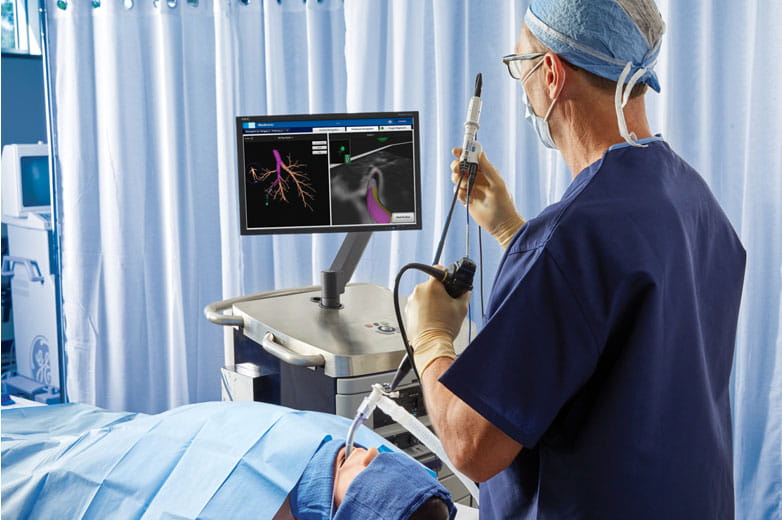 Navigational Bronchoscopy in Endoscopy suite.
“Under normal light conditions, the anatomy looks as it always does,” Dr. Towe says. “Combining the dye with a specific bandwidth of light allows us to see the area of concern while maintaining normal anatomic visibility of the surrounding lung tissue.”
Two scenarios highlight the benefits of these combined procedures for localizing lung lesions: detecting minute early-stage cancers and treating recurrent cancers, in which small tumors are often obscured by significant pleural adhesions.
“When lung cancers are first detected, they can appear as ground glass, like a grain of salt on a black background,” says Sameer Avasarala, MD, an Interventional Pulmonologist at University Hospitals and an Assistant Professor at the School of Medicine. “With smaller nodules, some of the inputs that surgeons have traditionally used to locate them are not as obvious, so these techniques can be helpful.”
Dr. Avasarala explains that a CT is performed first. The patient is then anesthetized and taken to the bronchoscopy suite, where Dr. Avasarala or his interventional pulmonology colleagues use a robotic platform to map a pathway to the nodule.
“Once we navigate to the precise site, we are able to place the dye-soaked fiducial coil through the bronchoscope around the nodule,” he says. “Our health system is fortunate to have advanced imaging, with CT scanners inside the bronchoscopy suite, which allows us to complete these procedures with very high fidelity.”
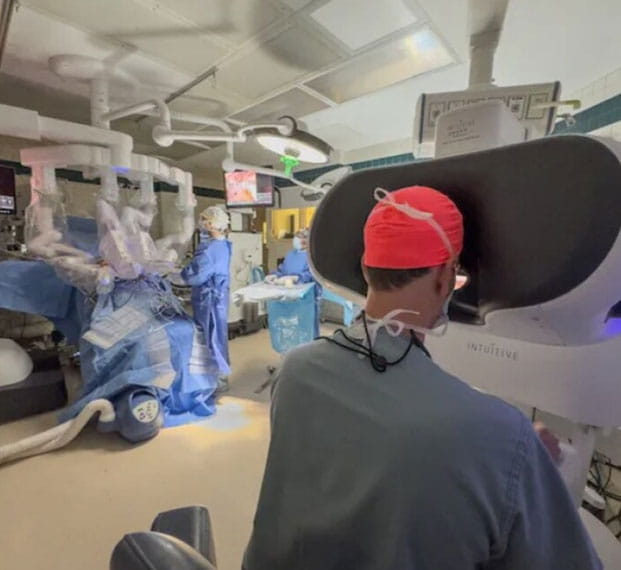 Robotic thoracic surgical resection in Mather OR.
Still anesthetized, the patient is taken directly to the operating room. There, Dr. Towe or another thoracic surgeon performs a robotic wedge resection of the lung. “When we turn on the fluorescent camera, the coil serves as a beacon to precisely guide resection and provides the confidence that we are achieving clear margins and preserving healthy lung tissue,” he says. “Our goal is to treat patients quickly, precisely and aggressively to give them the best chance of a happy, healthy life.”
Optimizing Care Delivery
In recent years, University Hospitals has expanded its use of surgical robotics and imaging technologies. “I think these advances foster the collaborative nature of our program, enabling us to work in concert with a team-based approach so that patients benefit from experts throughout their health journey,” Dr. Towe says. “We continue to push the boundaries to deliver great care.”
Patients also benefit from the streamlined logistics of the combined procedure. “We are very cognizant that day-to-day life does not pause for our patients who need to address their health care needs,” Dr. Avasarala says. “This approach helps alleviate some of the strain of scheduling and runaround from a patient’s perspective because the procedures can be completed in one day, and recovery time is shortened.”