


UH Rainbow Neonatology Researcher Earns Prestigious NIH Grant for Further Study of CPAP Effects on Lung Development
February 24, 2026

Innovations in Pediatrics | Spring 2026
Premature infants in the NICU often have the life-threatening complication of immature, poorly functioning lungs. Interventions such as supplemental oxygen or continuous positive airway pressure (CPAP) are necessary to get the baby through the immediate postnatal period until the lungs can function properly. However, according to research underway at UH Rainbow Babies & Children’s, these lifesaving modalities -- even the more “benign”-seeming CPAP -- may have unintended consequences and should be better understood.
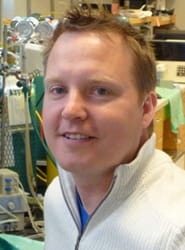 Peter MacFarlane, PhD
Peter MacFarlane, PhD, William and Lois Briggs Research Chair in Neonatology and Director of Neonatology Basic Research at UH Rainbow, is doing just that. With a second federal grant on this topic from the National Institutes of Health, he is using a mouse model to determine whether CPAP leads to airway hyperreactivity and later wheezing and asthma – and which molecular pathways may be implicated in this process.
The first step was determining whether he and his team could fashion a CPAP device for a newborn mouse.
“We had two questions: Could we give CPAP to a mouse in a way that closely mimics a clinical setting, and can we mimic some of the phenotypes in the way that CPAP might impact lung development and airway reactivity later in life,” he says. “I started out with a few simple experiments, and they worked. We've been able to show that CPAP alone leads to airway hyperactivity, in part by promoting smooth muscle proliferation and activation of other downstream pathways.”
With this new NIH grant, Dr. MacFarlane and his team look to build on these findings, motivated by the clear clinical need.
“Supplemental oxygen can cause lung injury and predisposes the infant to asthma and wheezing later in childhood,” he says. “Recently we have begun to see that neonatal CPAP could also have similar unfortunate side-effects.”
To generate needed answers, Dr. MacFarlane is using a mouse model of neonatal CPAP and fetal human smooth muscle cells. This allows for determining the effects of mechanical stretch on the airways, specifically smooth muscle cell development, and how it contributes to wheezing.
“We propose that mechanical stretch imposed on the lung by CPAP activates stretch-sensitive mechanisms that cause the airways to become hyperreactive, a characteristic feature of wheezing and asthma,” he says.
Dr. MacFarlane says he hopes the results of his research will ultimately help inform the ongoing conversation around preterm infants and CPAP.
“Our data will be the first to offer some insight into how CPAP impacts airway reactivity and wheezing disorders in former preterm infants,” he says. “We hope it will be crucial in guiding the clinical care of preterm infants in a way that minimizes the adverse effects of these respiratory interventions and maximizing their benefits. There’s a big push to use CPAP, so the idea of trying to show that CPAP alone should be used cautiously is one of the longer-term goals of the project.”
Still, Dr. MacFarlane posits that research may show that CPAP might be used in a more optimal way.
“If we can tease out what sort of CPAP is having certain effects, whether it's a high level of CPAP, a low level of CPAP, CPAP for a shorter duration, for a longer duration, then we may be able to find the optimal kind of dose of CPAP where we can optimize the benefits without introducing all of these side effects,” he says.
Dr. MacFarlane and his colleagues are also testing different pharmaceutical compounds to determine their effect on different molecular pathways associated with CPAP-related lung effects – although these are far from being approved for clinical use.
For now, the tiny mice with the CPAPs offer the best chance for greater knowledge and applicability.
“If we can actually start to get some definitive answers, at least in a mouse model, that can be used to guide how clinical decisions should be made for preterm infants,” Dr. MacFarlane says.
Contributing Expert:Peter MacFarlane, PhD
Director of Neonatology Basic Research
UH Rainbow Babies & Children’s Hospital