


Upper Airway Sleep Health: A New Perspective
December 03, 2025
Innovations in Pulmonology, Critical Care & Sleep Medicine | Fall 2025
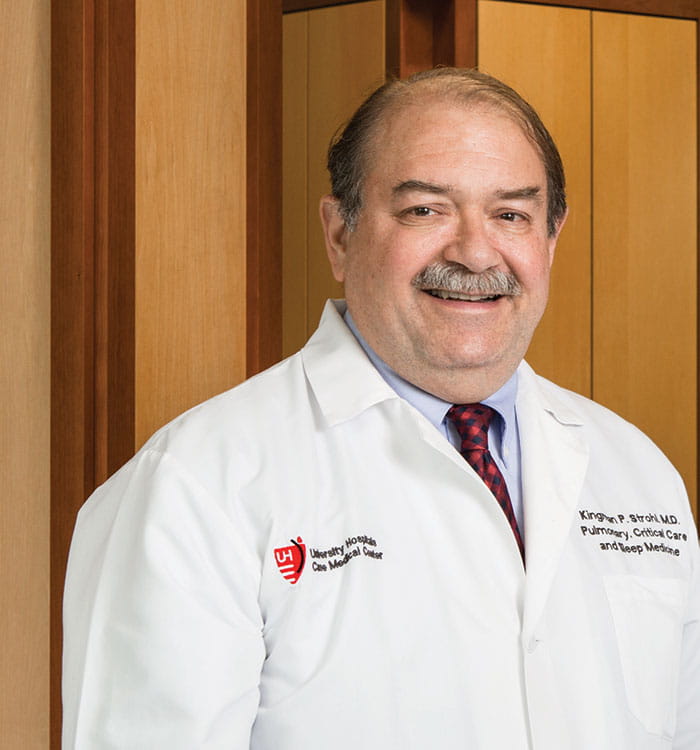 Kingman Strohl, MD
“Upper airway sleep health is keeping the airway open enough so it doesn't disturb sleep too much,” says Kingman Strohl, MD, Director of the Sleep Medicine Fellowship Program at University Hospitals Cleveland Medical Center.
Underpinning that purposefully simple statement is University Hospitals (UH) Cleveland Medical Center’s distinguished history as a national leader in sleep and pulmonary medicine. In the 1980s, pioneering UH physician-scientist Neil S. Cherniack, MD, led a team of investigators who received one of the largest National Heart, Lung and Blood Institute grants to examine respiratory control and the muscles and sensations relevant to respiratory health during wakefulness and sleep.
Rising to dean and vice president at Case Western Reserve University School of Medicine, Dr. Cherniack’s theoretical models and studies led to innovative approaches such as hypoglossal nerve stimulation, the development of negative pressure around the neck and drugs to treat obstructive sleep apnea (OSA). Legacies of his work include launching the UH Sleep Medicine Program and the Sleep Medicine Fellowship at UH Cleveland Medical Center.
“In 1993, University Hospitals’ sleep program was the first to demonstrate that a fine-wire electrode placed into the hypoglossal nerve could help keep the airway open,” says Dr. Strohl. “This work, supported by Medtronic, led to a role in the Phase 3 trials of the Inspire device, approved in 2014 and widely used today for OSA.”
Dr. Cherniack emphasized feedback control concepts in OSA. “The brainstem acts as the controller for coordinating upper airway muscles with breathing and receives sensory feedback from the upper airway and respiratory systems, and chemo- and mechano-receptors,” Dr. Strohl says. “As well, it wakes up individuals to break their sleep apnea. Recently, we have settled into the idea that what is happening in sleep apnea is a failure of the healthy brainstem adaptation and resiliency to maintain adequate flow to the lungs.”
Breathing during sleep is maintained through coordinated neural and mechanical mechanisms that prevent hypopnea, apnea or increased airway resistance, enabling unobstructed airflow and effective ventilation. During sleep, a fall in neural drive always starts an apnea and can affect the pharynx, soft palate and tongue. In turn, that leads to collapsibility of the upper airway and pathophysiological consequences of hypoxia and arousals from sleep, which strain the heart and brain. A non-obstructive, or so-called central apnea, can also interrupt sleep.
Personalizing OSA Treatment
Current estimates are that up to 26 percent of U.S. adults aged 30 to 70 have OSA, and 10 percent of children have obstructive sleep disordered breathing.
“This disorder, like hypertension and diabetes, must have a latent phase before people are recognized by consequences, such as intermittent snoring, poor sleep, daytime fatigue or cardiovascular complications,” Dr. Strohl says. “We think that we can be better informed of OSA origins and offer earlier interventions in its latent phase.”
Management of recurrent OSA is tailored to a person's presenting features (phenotype) and causes (endotype).
In adults, wake risk factors are male sex, age and craniofacial structures; obesity occurs in 50 percent of cases.
Disease phenotypes include:
- Interfering and excessive daytime sleepiness
- Disturbed sleep called insomnia
- Intermittent snoring and pauses during sleep
- Unexplained nocturnal arrhythmias, angina or polyuria
Treatment may involve recommending CPAP, an oral appliance, positional therapy, weight management or avoidance of sedatives.
Endotypes causing OSA include:
- Sleep-related fall in drive
- Wider swings in ventilation with arousals (high gain producing recurrence)
- Collapsibility of the upper airway causing obstruction (anatomy)
- Impaired pharyngeal dilator muscle response (impaired adaptation, a new drug target)
Personalized treatment is achieved by aligning therapy to one or more of these pathways.
Continuing to Advance Upper Airway Understanding
Today, UH sleep medicine physician-scientists strive for upper airway sleep health.
“We are looking to identify OSA and treat it earlier in a person’s life within the broader concept of Sleep Health,” Dr. Strohl says. “How do individuals lose upper airway stability and resiliency and develop functional impairment over time in response to loading. Loads — such as genetics, aging, male gender, obesity, diabetes, hypertension, socioeconomic status and family history —probably add up progressively.
“Maintaining brainstem health is fundamental at birth,” Dr. Strohl says. “When loads persist for years or even decades, the person finally presents with symptoms. Our sleep medicine faculty are testing this concept using both preclinical and human models.”
For more information, contact Dr. Strohl at Kingman.Strohl@UHhospitals.org.
Contributing Expert:
Kingman Strohl, MD
Director, Sleep Medicine Fellowship
University Hospitals Cleveland Medical Center
Professor of Medicine, Physiology and Biophysics
Case Western Reserve University School of Medicine