


University Hospitals Adopts MBS-IMP to Strengthen Dysphagia Care Across System
December 16, 2025
Innovations in Ear, Nose & Throat | Fall 2025
University Hospitals is improving care for patients with swallowing disorders through the systemwide adoption of the Modified Barium Swallow Impairment Profile (MBS-IMP). Development of the standardized tool began in 2005 by Bonnie Martin-Harris, PhD, and a team at the Northwestern University Feinberg School of Medicine.
This evidence-based evaluation provides an objective framework for analyzing swallowing physiology during videofluoroscopic swallow studies, helping clinicians identify the root cause of impairments and design more-effective treatment plans.
 N. Scott Howard, MD, MBA
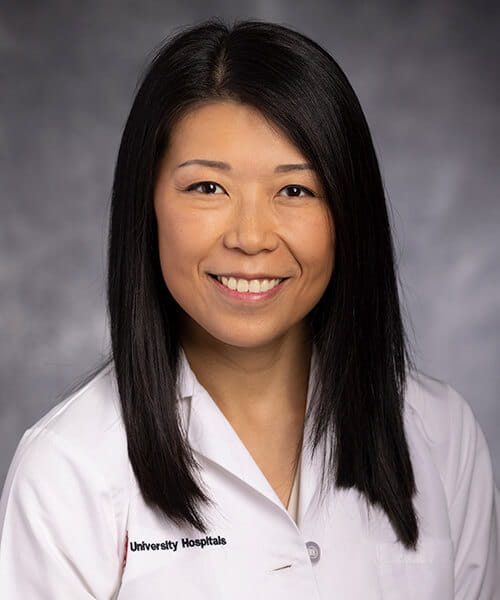 Nina Zhao, MD, MAEd
“Moving to MBS-IMP has been a game-changer for how we assess and manage swallowing disorders,” says N. Scott Howard, MD, MBA, Chief of the Laryngology Service and Director of the Voice, Airway and Swallowing Center at the University Hospitals Ear, Nose & Throat Institute. “Having a shared language between our speech-language pathologists [SLPs] and our physicians aligns everyone to ensure we are on the same page as we review studies, ultimately leading to better care for our patients.”
Over time, these improvements translate into higher confidence, safer diets, reduced aspiration risk and better quality of life.
Advancing Swallowing Care
The success of this initiative is complemented by broader system efforts to standardize the evaluation and management of dysphagia. Much of this work is led by Nina Zhao, MD, MAEd, a laryngologist and Associate Residency Program Director for the Department of Otolaryngology – Head and Neck Surgery at University Hospitals.
Dr. Zhao’s clinical and research interests include refining diagnostic approaches and advancing care pathways for patients with swallowing disorders. Along with her colleague, Alexis Nahra, MA, SLP-CCC, a speech language pathologist specializing in swallowing therapy, Dr. Zhao is focused on advancing diagnostic precision and innovative treatment for patients with complex swallowing disorders.
“When we are conducting a standard fluoroscopic study of a patient’s dynamic swallow, the MBS-IMP provides us with a standardized protocol and rating form for evaluating those findings,” Dr. Zhao says. “Interpreting the study is nuanced; if we are seeing thousands of swallows using the same parameters, we begin to develop an internal sense of what is normal or abnormal.”
Another standardization that University Hospitals has implemented involves defining both the consistency and quantity of barium administered to patients.
“When I am trying to better understand what the patient is going through, it is helpful to have a specific measured bolus size,” Dr. Zhao says. “We have determined at UH that we want our teaspoon to be five milliliters and a cup to be 20 milliliters to provide procedural context when planning interventions.”
While the traditional MBS study relied on descriptive narrative and subjective interpretation, the MBS-IMP provides a validated, physiologic framework that quantifies 17 components of oral, pharyngeal and esophageal function. The scoring system pinpoints which mechanisms are impaired, rather than simply documenting aspiration or residue.
Enhancing Systemwide Standardization
The MBS-IMP also helps track a patient’s progression over time and reduces variability between test administrators.
“Overall standardization of reporting is something we have been working on as a system over the past six years I have been at University Hospitals,” Dr. Howard says. “This is the next step, allowing us to standardize this crucial study at the highest level, which provides a significant benefit to our patients.”
Currently, 85 percent of University Hospitals’ speech language pathologists (SLPs) who conduct swallow studies are fully trained and credentialed in MBS-IMP.
“The impressive level of adoption has brought greater consistency and collaboration between our SLPs, otolaryngologists and radiologists across our hospitals and rehabilitation sites,” Dr. Howard says. “Accolades to our speech and language pathology leadership for taking on this mission and pushing over the past year to get this done — it is a great example of a successful systemwide initiative.”
For more information or to refer a patient for treatment, call the UH Voice, Airway and Swallowing Center at 216-844-5055.
Contributing Experts:
N. Scott Howard, MD, MBA
Director, Voice, Airway and Swallowing Center
University Hospitals Ear, Nose & Throat Institute
University Hospitals Cleveland Medical Center
Associate Professor
Case Western Reserve University School of Medicine
Nina Zhao, MD, MAEd
Associate Residency Program Director
Department of Otolaryngology — Head and Neck Surgery
University Hospitals Cleveland Medical Center
Assistant Professor
Case Western Reserve University School of Medicine