


UH Leads Way in Endourology by Advancing Care for Patients with Kidney Stones
December 10, 2025
UH Innovations in Urology | Fall 2025
Approximately 12 percent of the worldwide population has, or will have, kidney stones. In the United States alone, this painful condition drives many people to the emergency room every year.
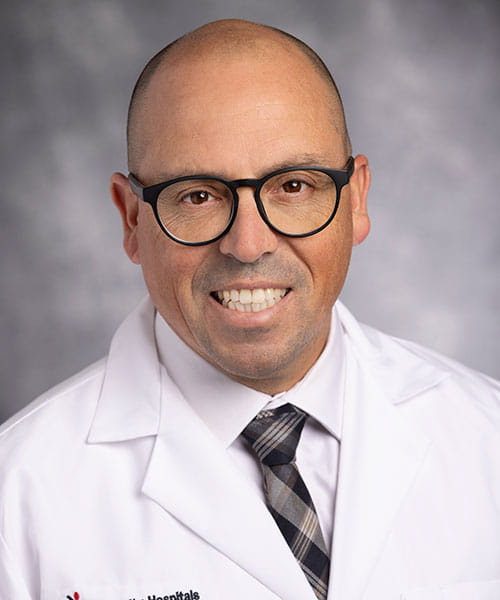 Jose Salvado, MD
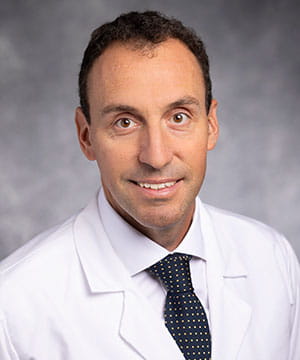 Felipe Pauchard, MD
Unfortunately, once someone develops a stone, it is almost sure to recur. Furthermore, up to half of people who have asymptomatic stones will develop symptoms within three years of diagnosis.
To address this serious – and prevalent – condition, University Hospitals Urology Institute is expanding and enhancing its endourology program.
Jose Salvado, MD, Chief of the Stone Disease Division, and Felipe Pauchard, MD, endourologist with the Stone Disease Division, joined the UH Urology Institute in early 2025 to achieve a lofty goal: create a new stone clinic and offer patients a comprehensive, multidisciplinary approach to stone care, which includes incorporating new technology and providing world-class training to endourology residents.
More Than ‘One-and-Done Surgery’
Kidney stones are painful to pass and those larger than about 7 mm normally require surgery. Since they recur, it’s important to also understand where and why stones develop.
“Stone care is so much more than a one-and-done surgery,” Dr. Salvado says. “We have found that about 85 percent of the time, diet contributes to the formation of kidney stones. In developed countries, we tend to consume a lot of salt and meat and not drink enough water.
“As part of our multi-disciplinary approach, we will see patients in the Stone Clinic following surgery. Patients will meet with their endourologist and a dietitian and a nephrologist – all at the same time and place. This integrated team will address patients’ diets and make a plan to reduce their risk for developing new stones.”
The Stone Clinic ultimately should reduce visits to emergency departments, ensure prompt treatment when stones become symptomatic and improve patient outcomes, Dr. Salvado says.
Stone Busters Annual Symposium
Despite the humorous allusion of its name, Stone Busters is a very serious course for healthcare professionals and medical students worldwide who treat patients with kidney and bladder stones. UH hosted the inaugural Stone Busters conference, titled Mastering Laser Endourology, in October 2025, to great success.
“Stone Busters is the academic arm of our multidisciplinary stone program,” Dr. Salvado says. “UH invited renown national and international endourologists for a day-and-a-half educational conference. Guest instructors included Olivier Traxer, MD, Professor of Urology at Sorbonne University in Paris. Dr. Traxer is considered the ‘father of endourology.’”
The conference highlighted numerous and recent urological innovations. Because the size of the conference was purposefully limited, attendees had opportunities to engage with experts in an intimate setting.
There have been a lot of innovations in this space recently, Dr. Salvado says. For example, newer models of sheaths are now much more flexible.
“Suction Access Sheaths allow us to apply lasers to destroy stones and, at the same time, aspirate the fragments,” he says. “The rest of the world has been using this technology for the last five years, but it’s new in the U.S. Manufacturers are also offering smaller endoscopes to accommodate people who have a narrow ureter, making it possible to treat more patients in a less invasive way.”
Other innovations in stone treatment include new laser therapies and the CVAC System, which uses laser therapy and a vacuum to remove residual fragments during treatment, minimizing potential problems post-procedure. While holmium:YAG laser has provided minimally invasive and effective treatment for stones, newer laser technologies offer additional options and advantages.
“We are incorporating all of these advances at the UH Urology Institute and educating the next generation of endourologists on these practices,” Dr. Salvado says.
UH Driving the Future of Stone Care
Planning for Stone Busters 2026 is underway and in addition to stone treatment, next year’s conference will include innovations in the care of men who have Benign Prostate Hyperplasia (BPH).
“There has been a lot of sporadic general treatment of kidney stones throughout Cleveland,” says Lee Ponsky, MD, Chair of the Department of Urology at University Hospitals Cleveland Medical Center and Director of the UH Urology Institute. “With the addition of Drs. Salvado and Pauchard, we are excited to have such a high level of expertise at UH and to be able to provide comprehensive, dedicated stone management, efficiently, and at the highest level of technology and approaches. In addition to leading an innovative clinical program, Drs. Salvado and Pauchard are also conducting research and trialing the latest technology available worldwide.”
For more information about Stone Busters or the Stone Clinic call Dr. Salvado at 440-328-8256 or Dr. Pauchard at 440-292-3795.
Contributing Experts:
Jose Salvado, MD
Chief, Stone Division
University Hospitals Urology Institute
University Hospitals Cleveland Medical Center
Chairman
University Hospitals Urology Institute
Leo & Charlotte Goldberg Chair in Advanced Surgical Therapies
Master Clinician in Urologic Oncology
Director, Urologic Oncology Center
University Hospitals Seidman Cancer Center
University Hospitals Cleveland Medical Center
Professor
Case Western Reserve University School of Medicine