


7th Annual UH Research & Innovation Day Places Groundbreaking Research at the Heart of Academic Medicine and Transformative Patient Care
December 07, 2025
UH Research & Education Institute
The 7th Annual UH Research & Innovation Day, “Innovating Today for the Cures of Tomorrow,” took place on Thursday, October 30, shining a bright light on a broad spectrum of cutting-edge research at University Hospitals.
“UH Research & Innovation Day is an uplifting event that cements the reason we are here,” said Daniel Simon, MD, President, Academic & External Affairs and Chief Scientific Officer, and the Ernie and Patti Novak Distinguished Chair in Health Care Leadership for University Hospitals. “Yes, we are here to take care of patients, but what we are here to find are the newest drug, device and cell-based therapies for patients who are out of options.”
This annual event brings together researchers from diverse disciplines to discuss some of medicine’s most timely research topics and advances showcasing scientific breakthroughs and innovative approaches to research at UH.
Program Includes Multidisciplinary Studies from Bench to Community
This year’s program comprised seven research faculty who provided perspective on the depth and breadth of research underway at UH, highlighting child and adolescent psychiatry, microbiome pharmacology, olfactory science, pancreatic cancer, prion disease and urogynecology and sharing insight into their respective research process, key findings, and plans moving forward.
Douglas Brubaker, PhD, Assistant Professor, Department of Pathology, Center for Global Health and Diseases, Case Western Reserve University (CWRU) School of Medicine, detailed the use of advanced computational and biological methods to understand mechanisms of host-microbiome interactions and immune cell biology for effective drug development. His team are building large pharmacology databases with gut and vaginal biome data for their research.
“When you generate data bases like this, with massive amounts of training data, it changes the kind of methods you can employ to understand biology,” said Dr. Brubaker. “That’s where we’ve started to move away from more statistical approaches to deep learning and AI-base methods.”
Molly McVoy, MD, UH Rocco L. Motto Professorship in Child & Adolescent Psychiatry, Child and Adolescent Psychiatry Division, Associate Professor Psychiatry CWRU School of Medicine, spoke of using science to inform collaborations with schools and teachers to better serve the mental health needs of children and adolescents, identifying ways to best support and train teachers and improve student mental health.
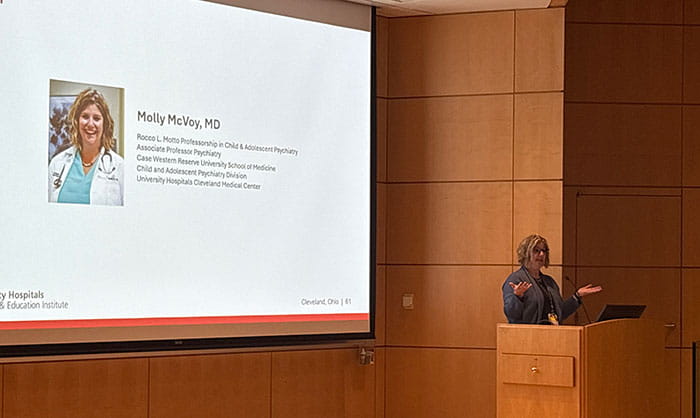 Molly McMoy, MD presenting.
“We are clinicians embedded in the community,” says Dr. McVoy. “We need to do better science to take better care of patients.” Dr. McVoy and her team plan to launch a pilot study at several schools to identify how best to support teachers.
Matthew P. Anderson, MD, PhD, Investigator and Co-Director, Oxford-Harrington Rare Disease Centre, Sylvia K. Reitman Chair in Discovery and Innovation, Harrington Discovery Institute at UH, Senior Attending Physician, Professor of Pathology, Division of Neuropathology, CWRU School of Medicine, who developed the first genetic mouse model of a frequent form of autism, spoke about genetic research and big data sets expanding the understanding of the mechanisms underlying autism spectrum disorders (ASD), noting studies that have uncovered behavior-controlling mechanisms in some ASD.
Jennifer Villwock, MD, Vice Chair of Research UH Ear, Nose & Throat Institute, Professor of Otolaryngology, CWRU School of Medicine, who joined UH in early fall, shared her research into olfactory dysfunction as a disease marker. She aims to understand how patterns of olfactory performance, called olfactory phenotypes, can be used to predict cognitive impairment, and how they might correlate with other indicators of cognitive impairment, such as plasma biomarkers of Alzheimer’s disease.
Brian Appleby, MD, Director, National Prion Disease Pathology Surveillance Center at UH, Professor, Departments of Neurology, Psychiatry, & Pathology, CWRU School of Medicine spoke of the quest to find an effective treatment for prion disease, a rare group of progressively neurodegenerative disorders caused when normal prion proteins misfold and cluster together. UH was the first site activated in a groundbreaking prion disease treatment trial, Ionis Pharmaceuticals’ international, first-in-human study of a prion protein-lowering treatment approach utilizing antisense oligonucleotide, a synthetic nucleic acid sequence developed to reduce the amount of the normal prion protein.
David Sheyn, MD, Director, Division of Urogynecology and Reconstructive Pelvic Surgery at UH and Associate Professor CWRU School of Medicine, focuses on research to leverage large data to explore mechanisms and treatment outcomes in pelvic floor disorders, urinary tract infections and menopausal health. He is leading a Patient-Centered Outcomes Research Institute (PCORI)- funded study comparing buking versus mesh sling for treating stress urinary incontinence at the time of vaginal prolapse repair, and shared outcomes to date.
The unwavering commitment of talented, groundbreaking researchers who work tirelessly to uncover new findings that transform medicine was readily apparent throughout the presentations. Also evident was the need to stay focused on achieving productive research and training new generations of scientists to best meet patient care needs.
“Research really has to be our why at an academic medical center like UH,” said Jordan Winter, MD, Director of Surgical Services at UH Seidman Cancer Center, Division Chief of Surgical Oncology and Co-director of the Developmental Therapeutics Program for the Case Comprehensive Cancer and the event’s keynote speaker. As clinicians and scientists, “we love everything we do, but what gets our juices flowing, what makes us bubble up with enthusiasm and energy more than anything, is to make a discovery or light that spark in a post-doc or trainee in a way that launches a career or scientific investigation.”
Dr. Winter’s keynote address, “IDH1: A Window into the How and Why of Bench to Bedside Research,” traced the arc of his research examining the underlying mechanisms of pancreatic cancer. He and his team identified IDH1, a metabolic enzyme that enables pancreatic cancer cells to thrive in nutrient deprived conditions, as a new therapeutic target.
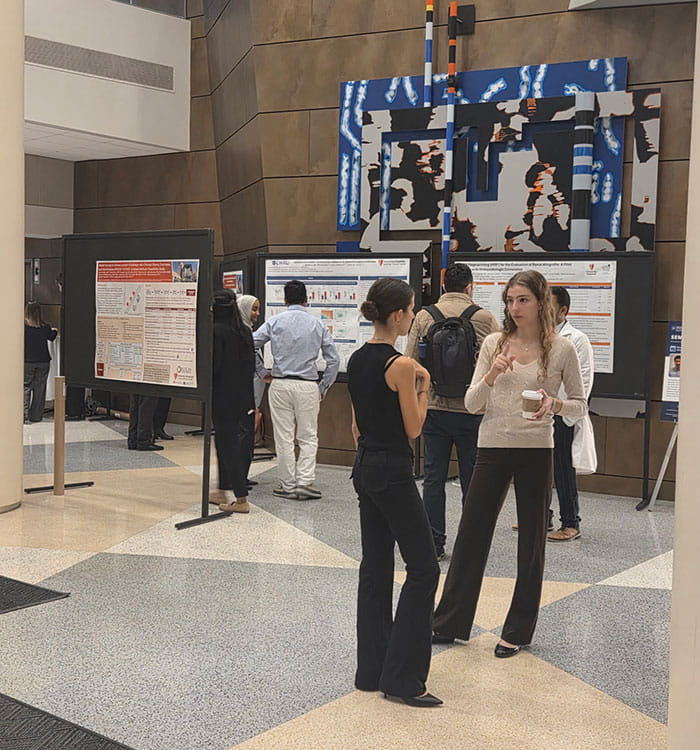 Poster Session at the 7th Annual Research & Innovation Day 2025.
Additionally, the symposium featured a display of 56 scientific posters prepared by undergraduates, medical students, fellows and post-doctoral fellows, selected from among 70 abstracts submitted. One of the highest scoring abstracts, “Development of a Mouse Model for Geleophysic Dysplasia to Investigate Disease Mechanisms and Therapeutic Approaches” was presented by Divya Sivakumar, a biology undergraduate student in the laboratory of Timothy Mead, PhD.
Daniel Spratt, MD, Chair of the UH Department of Radiation Oncology, Vincent K. Smith Chair in Radiation Oncology for the UH Seidman Cancer Center, Associate Chief Scientific Officer and Medical Director for the Center for Clinical Research, served as the event’s moderator.
Multiple presenters acknowledged that research can be a difficult and challenging endeavor, emphasizing the need to invest and fund research, particularly at a time when research funding is tight or uncertain. Attendees were encouraged to stay focused on the benefits of scientific exploration and innovation.
“It’s about persistence,” said Dr. Spratt. “You’re not going to find the cure to anything overnight.”