


Bridging Trauma Care and Scientific Discovery
September 22, 2026
UH Research & Education Institute
James Ross, MD, is a trauma surgeon and physician-scientist at University Hospitals and Assistant Professor of Surgery at Case Western Reserve University (CWRU) School of Medicine, whose translational research examines how hemolysis following traumatic injury contributes to organ damage and other complications.
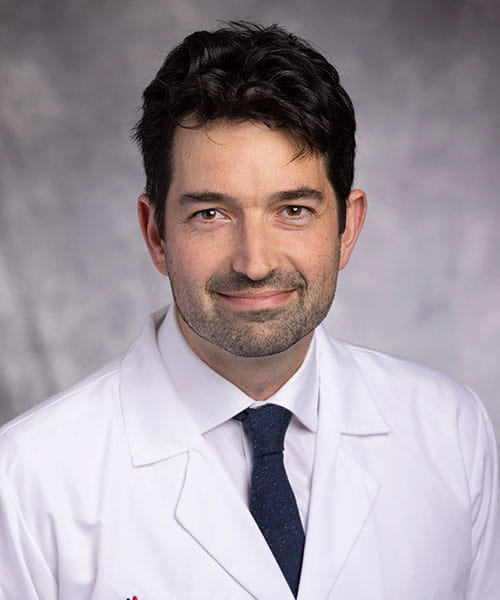 James Ross, MD
Even after bleeding is controlled and injuries are treated, a quarter of patients go on to develop organ injury and changes to the immune system that increase their susceptibility to sepsis and other infections. Dr. Ross is investigating whether early hemolysis is a driver of these complications, potentially providing a basis for using existing agents such as haptoglobin or hemopexin during early trauma resuscitation to reduce organ damage and other adverse outcomes. Ultimately, this work could help physicians identify at-risk trauma patients earlier and develop treatments that reduce life-threatening complications.
While the effects of hemolysis have been studied in conditions such as sepsis and acute lung injury and during cardiopulmonary bypass, its role in trauma remains an emerging area of research.
“It’s really an interesting area to do research in because there is so much we don’t know about the biology and early phase of illness,” says Dr. Ross. “Our study a couple of years ago was one of the first to demonstrate that patients have elevated free hemoglobin after injury.”
Dr. Ross also coordinates research for the trauma division, with a focus on outcomes and improving clinical decision-making in trauma care. This work examines questions such as the optimal ratio and use of limited blood products during early resuscitation, best practices for caring for trauma patients in the ICU and how to identify patients at risk for complications.
New Research
In July, Dr. Ross received a five-year National Institutes of Health K08 Career Development Award to support his research into the biology of hemolysis and its role in organ injury following trauma. His work seeks to better understand why hemolysis occurs after traumatic injury, how it contributes to organ damage and which patients may be particularly susceptible to hemolysis-related complications.
“It focuses on understanding the biology of how and why hemolysis occurs in trauma, which patients are particularly susceptible to hemolytic-related injury and then how it sets the stage for my next grant, which hopefully will be about how we can treat this,” says Dr. Ross.
Dr. Ross is laying the groundwork for future approaches to treating traumatic injuries, reducing complications and improving patient outcomes.
Early Influences
Born in Oxford, England, Dr. Ross says his interest in science was shaped in part by his father, a now-retired biochemist who worked on early MRI techniques. His family moved to California when he was a young boy, and he recalls spending Sundays playing in the corner of his father’s lab — an early glimpse, perhaps, of his own future in science.
Dr. Ross attended the University of Oxford, where he studied biochemistry, before earning his medical degree from the University of Colorado Anschutz Medical Campus. During medical school, he was drawn to the immediacy of trauma medicine and the opportunity to make a meaningful difference during critical moments in patients’ lives. A trauma rotation at Denver General Hospital further shaped his interest in the field, showing him firsthand how basic science research could be translated into patient care.
Dr. Ross completed his general surgery residency at the University of California, San Francisco (UCSF) in 2021, where he spent two dedicated years conducting research through a T32 training grant. Working in the pulmonary critical care division, he studied acute lung injury and acute respiratory distress syndrome (ARDS) using mouse models and ex vivo perfused human lungs that had been declined for transplantation. This work sparked his interest in hemolysis, as emerging evidence suggested that excess free hemoglobin in the bloodstream could contribute to lung and other organ injury. He later completed a fellowship in Trauma and Surgical Critical Care at the University of California, Davis.
Mentorship
Dr. Ross initially considered pursuing a PhD in basic science but ultimately chose a career that combined research with clinical practice because he enjoyed interacting with patients. During his residency, one of his most influential mentors was Michael Matthay, MD, a pulmonary and critical care physician-scientist at UCSF, who showed him how physicians can balance patient care with meaningful basic science research.
During his fellowship at UC Davis, trauma surgeon and physician-scientist Rachael Callcut, MD, MSP, provided Dr. Ross the freedom to experiment with new ideas and the support to develop his research projects, including his work on hemolysis that he says became the foundation of his current lab. That combination of independence and support proved transformative to his career.
Dr. Ross says mentorship has remained vital to his professional development and career trajectory, particularly because combining clinical practice with laboratory research requires a distinct set of skills, training and perspective.
Today, he thrives in the collaborative environment across UH and CWRU that supports his research. Kenneth Remy, MD, serves as a key mentor, bringing expertise in critical care, hemolysis and sepsis, while collaborations with CWRU’s engineering teams have supported innovative approaches, including microfluidic models to study free hemoglobin and red blood cell behavior.
Further along in his career, Dr. Ross is paying that mentorship forward. As a medical educator, he enjoys working with medical students in his lab and guiding clinicians and scientists at earlier stages of their careers, demonstrating that clinical practice and research can be successfully combined.
“Not only do I benefit from having (students) here, but I want them to see that this type of work is interesting, and that you can do it alongside clinical work” he says.
Dr. Ross encourages younger physician-scientists and trainees to pursue questions they genuinely care about, recognizing that meaningful progress requires sustained effort and commitment, something he knows firsthand.
Physician, Scientist and Mentor
For him, the connection between the lab and the clinical world is what makes being a physician-scientist so rewarding. The problems he sees in patients today can become the research questions he works to solve tomorrow.
Whether caring for critically injured patients, mentoring future physician-scientists or investigating new approaches to trauma treatment, Dr. Ross remains focused on translating scientific discoveries into better outcomes for patients.
Outside of work, Dr. Ross enjoys spending time with his wife, an otolaryngologist at UH, and their two children as well as running.
Tags: Research, Research & Education