



Screening Options for Breast Cancer
Breast cancer screening looks for signs of the disease before any symptoms are present. The goal of screening is to find cancer at an early stage, when it’s most treatable and curable.

Your health is important. Get expert care.
If you have symptoms that suggest breast cancer or have been diagnosed with breast cancer, call 216-844-3951 today to schedule an appointment with a cancer expert at UH Seidman Cancer Center.
To schedule a mammogram or other breast cancer screening at UH Seidman Cancer Center, call 216-844-2778.
Catching Breast Cancer Early
Breast cancer that is detected early, when the tumor is small and hasn’t spread, has nearly a 99 percent five-year survival rate.
Mammography is the recommended screening test for breast cancer. A screening mammogram is an X-ray image taken of the breast that detects changes that could be cancerous in people who have no signs or symptoms. The goal is to detect cancer when it’s small and more likely to be successfully treated.
3D Screening Mammogram (Tomosynthesis)
University Hospitals was the first healthcare provider in Northeast Ohio to offer tomosynthesis, a technologically advanced screening tool that uses three-dimensional imaging to detect breast cancer. This technology produces a 3D image of the breast, which provides doctors with a clearer view than conventional mammography. The result is that breast abnormalities are easier to see, even in dense tissue.
Screening Mammogram Recommendations
For women at average risk, a baseline (first) mammogram is recommended when they turn 40, followed by yearly screening mammograms.
If you’re at higher risk for developing breast cancer, your doctor will talk to you about ways to manage your risk, which could include starting screening at an earlier age or more frequently.
To schedule a mammogram at one of our multiple locations across Northeast Ohio, use our convenient scheduling tool to book your appointment online or call 216-844-2778.
Importance of Mammograms
Screening mammograms can find cancer in its earliest stages, when it’s most treatable and curable.
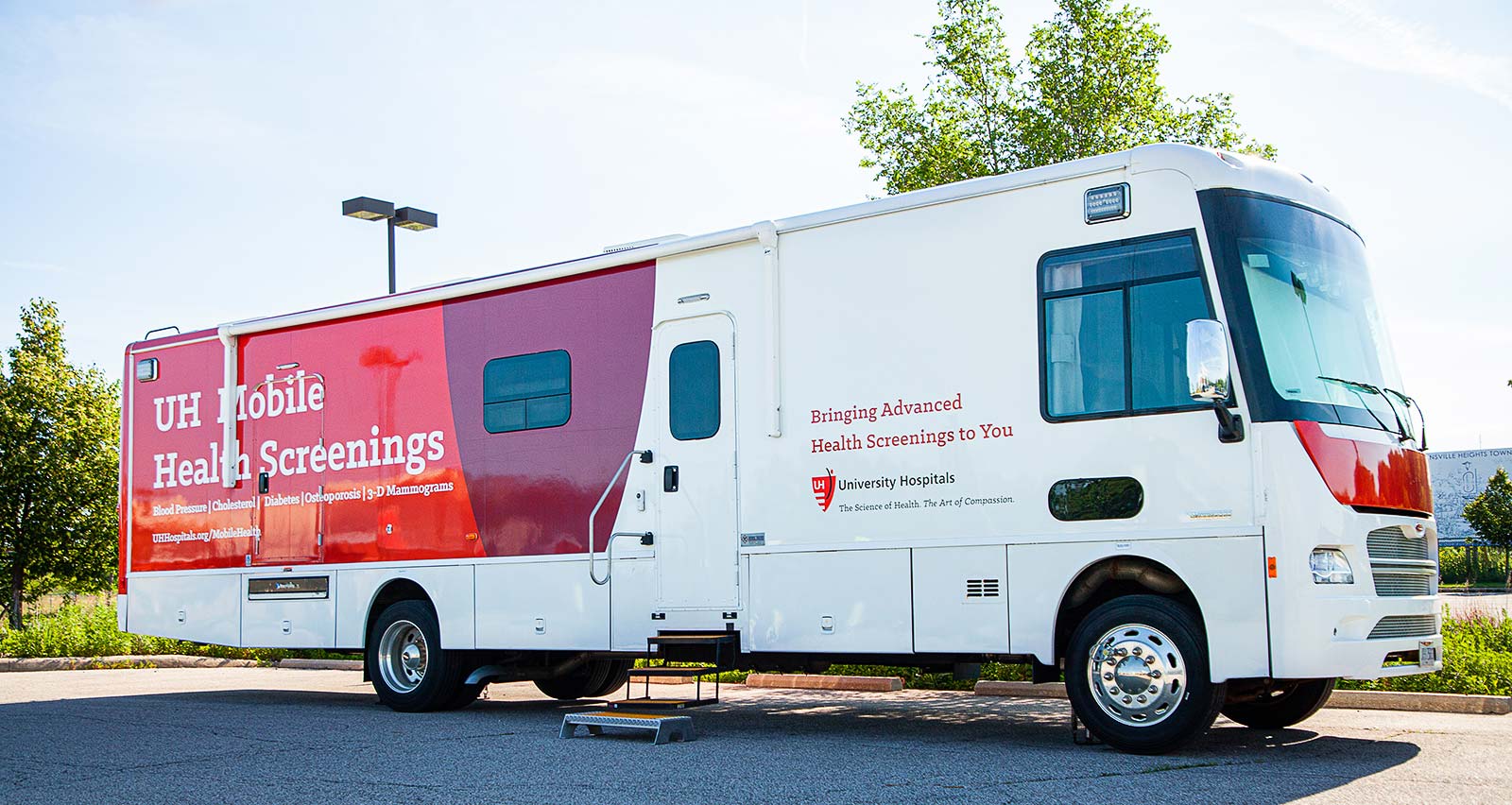
UH Mobile Health Screenings Program: Bringing Advanced Screenings to You
Our mobile health screening unit visits a variety of community locations to offer advanced 3D mammography screenings. Patients can schedule ahead of time and do not need an order. Appointments are required for the mobile health unit.
A licensed mammography technician performs all UH mobile mammograms. Results are interpreted by a UH board-certified breast imaging radiologist and mailed to you and your referring doctor.
Breast Ultrasound
A breast ultrasound can be useful for evaluating certain breast changes, such as lumps that can be felt but are not seen on a mammogram. Another screening tool, a breast ultrasound is particularly useful for women who cannot have a breast MRI for screening. Breast ultrasound may also be used to examine a suspicious area found on a mammogram.
Dense Breast Tissue
If a woman’s breasts have a higher proportion of glandular and fibrous tissue than fatty tissue, they are considered dense. Dense breast tissue can make it more challenging for a mammogram to identify tumors and other abnormalities. If you have dense breasts, in addition to receiving yearly mammograms, your doctor may recommend additional testing, including:
Fast Breast MRI Screenings
The Fast Breast MRI is a 10-minute, self-pay, low-cost examination. Studies have shown that this screening method is effective in detecting invasive breast cancers.
Women with dense breast tissue, women with an average or mildly elevated risk for developing breast cancer or women with a family history of the disease can schedule this supplemental screening test. Fast Breast MRI is available at several UH locations where breast MRIs are performed, including:
To learn more about the Fast Breast MRI program, call 216-844-1700 or speak to your physician.
Contrast Enhanced Mammography
University Hospitals was the first medical center in Northeast Ohio to offer contrast enhanced mammography, or CEM: a test that takes X-ray pictures of the breasts with contrast dye. CEM is similar to a mammogram, but the dye makes it easier for your healthcare provider to detect cancer. For women with dense breast tissue, this can be very helpful.
Transgender Breast Cancer Screenings
Transgender people have a different gender identity than the sex they were assigned at birth. Transgender women and men can develop breast cancer. Every transgender patient should discuss their breast cancer screening options with their healthcare provider.
Frequently Asked Questions
- Are mammograms effective after breast surgery?
-
Yes. Mammograms are equally effective after breast surgeries, including lifts, reductions and implants. When a woman reaches 40, she should get annual mammograms regardless of whether she’s had breast surgery or not.
- Is the radiation used in mammograms dangerous?
-
The risk of harm due to the radiation used in a mammogram is minimal. The low dose of X-ray radiation you receive from a mammogram is equivalent to the amount you are exposed to during a transatlantic flight. The lifesaving benefits of mammograms far outweigh any risks.
- Can I get a mammogram if I’m breastfeeding?
-
Yes. Although increased breast density during breastfeeding can reduce breast sensitivity, mammograms are still recommended. The American College of Radiology’s guidelines for pregnancy and lactation recommend pregnant or breastfeeding women continue their regular screening mammograms.
Breastfeeding mothers should pump before having a mammogram to minimize discomfort and improve the readability of the mammogram. If you’re pregnant, you will be provided a lead apron to shield your baby. The radiation to the baby is negligible.
- Do I need to get a mammogram if breast cancer doesn’t run in my family?
-
Yes. Mammograms are strongly recommended even for women who do not have a family history of breast cancer. Breast cancer is the most common cancer in women and nearly 75 percent of women who get the disease have no family history of it.
It is the second leading cause of cancer death and is the leading cause of death in premenopausal women. One in eight women will develop breast cancer in their lifetime.
- If I do my monthly breast self-exams, do I still need to get mammograms?
-
Yes. Monthly self-exams should be done in addition to annual screening mammograms. Mammograms are better at finding cancer when it is smaller and more treatable. Cancers detected through self-exams may be larger and more difficult to treat.
- I heard that African-American women are at higher risk for aggressive breast cancer. Should African-American women begin screening earlier?
-
Although breast cancer occurs more often in white women than in black women, black women are two times more likely to die from breast cancer than white women. For this reason, the American College of Radiology recommends that breast cancer risk assessment for everyone be performed before age 25. Based on this assessment, your doctor will determine if earlier or additional screening is appropriate for you.
- At what age can I stop getting mammograms?
-
Because breast cancer increases with age (20 percent of breast cancers occur in women 75 years or older), we recommend that women do not stop getting mammograms based solely on age. Other factors that older women should weigh when thinking about stopping mammograms include life expectancy, other health issues, and their intention to seek (and ability to tolerate) treatment if breast cancer is found.
- Since MRI is better than mammography at detecting breast cancer, why can’t I skip my mammogram and get an MRI instead?
-
Though MRI can detect most breast cancers better than mammography, mammograms are often better at detecting early-stage (called stage 0) breast cancer. For this reason, even higher risk women who are approved for breast MRI should also get mammograms.