


Research Experience in the Program
Research training is a core component of the Pediatric Endocrinology Fellowship and is intentionally structured to develop fellows as thoughtful scholars, critical consumers of the medical literature, and contributors to the advancement of pediatric endocrine care. Fellows complete 16 months of protected research time, with flexibility to extend research training for those interested in pursuing a basic science career pathway.
Early in fellowship, fellows receive structured mentorship to identify a focused research question and develop a feasible project. Formal training in research methodology is provided through the Case Western Reserve University Clinical Research Scholars Program, followed by dedicated time for protocol refinement, institutional review board submission, project execution, data analysis, and manuscript preparation. A divisional research curriculum provides personalized didactics in research methodology. Each fellow’s scholarly work is mentored by a faculty advisor and overseen by a Scholarship Oversight Committee to ensure academic rigor, appropriate scope, and timely progress.
Research funding is available to pediatric endocrinology fellows through the Department of Pediatrics at UH Rainbow Babies & Children’s Hospital via the Fellowship Research Award in Pediatrics (FRAP). Additional divisional funds are also available, and fellows are encouraged to collaborate with faculty mentors to pursue external grant funding when appropriate. Robust research infrastructure supports fellow projects, including access to research coordinators, research nursing support, and biostatistical consultation.
In addition to hypothesis-driven research, fellows complete a structured Quality Improvement (QI) experience and have opportunities for formal training in improvement science through the institution-wide Rainbow/MacDonald Quality Curriculum. This curriculum provides foundational instruction in QI methodology, measurement, and implementation and may be used to fulfill the fellowship QI requirement or form the basis of the fellowship scholarly project. Fellows also receive ongoing feedback through periodic research and QI updates presented during weekly divisional conferences.
Fellows may further develop scholarly skills through participation in the Evidence-Based Medicine (EBM) Scholars Program, which offers formal training in critical appraisal of the medical literature, guideline development, and application of evidence-based principles to clinical practice and policy. These experiences support fellows in meeting ACGME scholarly activity requirements while strengthening skills essential for academic and clinical leadership.
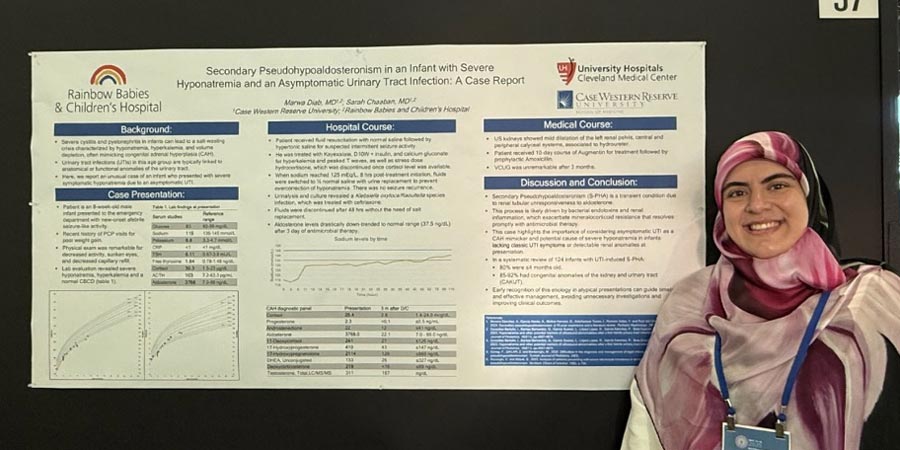
Scholarly dissemination is strongly emphasized. Fellows and faculty regularly present oral and poster presentations at national meetings, including the Pediatric Endocrine Society, the American Diabetes Association, The Endocrine Society, and the International Society for Pediatric and Adolescent Diabetes. Educational funding supports travel for all fellows to one meeting annually. Fellows also have the opportunity to collaborate with faculty on case reports or case series for national presentation and peer-reviewed publication. All fellows present their scholarly work locally at the annual Rainbow Babies & Children’s Hospital Fellow Science Day each June, reinforcing skills in scientific communication and academic presentation.
Recent Fellow Research Projects
- NF-kB c-Rel O-GlcNAcylation as a potential molecular therapeutic target regulating autoimmunity in type 1 diabetes (Best Overall Presentation, RB&C Fellow Science Day 2024)
- Exploration of Physical Literacy in Children with Type 1 Diabetes
- Acceptability of a Virtual Educational Intervention to Improve Diabetes Self- Efficacy and Glycemic Control in Adolescents and Young Adults with Type 1 Diabetes Mellitus
- The Prevalence of Nonalcoholic Fatty Liver Disease (NAFLD) in Children with Type 1Diabetes (T1D) and its Association with Arterial Stiffness
- Dietary Factors and Risk of Progression to Type 1 Diabetes Mellitus in TrialNet
- Comparing the Efficacy and Frequency of Complications of Insulin Glargine vs Insulin Degludec in a Pediatric Population with Type 1 Diabetes
- Prevalence of Nonalcoholic Fatty Liver Disease (NAFLD) in Children with Type 1 Diabetes (T1D) and its Association with Arterial Stiffness
- Characterization of Gut Microbiota in Lean and Overweight Type 1 Diabetes, and Healthy Controls
- Effect of Dietary Protein Intake on Post-prandial Hyperglycemia in Children and Adolescents with Type 1 Diabetes Mellitus (awarded Best Clinical Project, RB&C Fellow Science Day, June 2019)
- Continuous Glucose Monitoring (CGM) in Youth with Type 1 Diabetes Mellitus: Parental Anxiety and Parent Defined Outcomes
- Effect of Iodine on Thyroid Function in Very Low Birth Weight Infants
- Hepatic Steatosis in Patients with Cystic Fibrosis Related Diabetes: a Cross Sectional Analysis
- Disruption of T-Cell Homeostasis by Cyclin Dependent Kinase 5 Activity is Critical In Pathogenesis of Diet Induced Obesity
- Advanced Glycation End-Products and Skin Intrinsic Fluorescence, and Their Relationship to Inflammation, Oxidative Stress, and Cardiovascular Health in Young Women with Polycystic Ovary Syndrome
- Impact of Fitbit on Cardiovascular Fitness in Obese Adolescents Enrolled in a Weight Management Program
- Hair Cortisol as a Novel Biomarker of Hypothalamic Pituitary Adrenal (HPA) Axis in Children with Type 1 Diabetes
- Intensive Diabetes Clinic and Intermittent Use of Continuous Glucose Monitoring in Adolescents with Type 1 Diabetes Mellitus in Poor Glycemic Control
- The Role of Regulatory T Cells in the Pathophysiology of Type 1 Diabetes Mellitus
Recent Fellow Quality Improvement Projects
- Does the Use of Free T4 by Equilibrium Dialysis in a Rescreening Protocol for CongenitalHypothyroidism in VLBW Newborns Decrease Repeated Testing? (Leona Cutler Best Abstract in QualityImprovement, Pediatric Endocrine Society Meeting, 2024)
- Increasing the Rate of Formal Depression Screening for Type 1 Diabetes Mellitus Management inAdolescents and Young Adults
- Optimizing Education for Transition from Pediatric to Adult Type 1 Diabetes Clinic
- Protocol for Postoperative Care of Children and Adolescents after Thyroidectomy and Parathyroidectomy
- Evaluation of Adrenal Insufficiency in Eosinophilic Esophagitis
- Evaluation and Management for Risk of Adrenal Insufficiency in Infants after Prolonged Exposure to Systemic Glucocorticoids
- Mini-Dose Glucagon Treatment for Low Blood Sugar Rescue Card
- Screening for Congenital Hypothyroidism in Very Low Birth Weight Infants
- Standardization of Glucocorticoid Dosing Instructions in Patients with Adrenal Insufficiency
- Diabetes Action Plan: a Simple and Inexpensive Intervention to Prevent Diabetes Related Emergencies
- Optimizing Medical Management after Thyroidectomy
- Optimizing Safety in Entering Insulin Pump Orders in the Electronic Medical Record