


Education & Training for Infectious Disease Fellows
The foundation of our training program is a multifaceted clinical experience at three distinct training sites, paired with a thoughtfully designed two-year curriculum covering core topics in HIV, infections in transplant and immunocompromised hosts, infection control, antimicrobial stewardship and microbiology. Fellows also attend one half-day per week of continuity clinic dedicated to the care of persons living with HIV.
Quick Facts
Sponsoring Institution: UH Cleveland Medical Center
Program Name: Case Western Reserve University/University Hospitals Cleveland Medical Center Infectious Disease Fellowship Program
ACGME Accredited: ACGME
ACGME Program Number: 1463821154
Program length: Two years
Positions: Four fellows per year
Application: ERAS
Match: NRMP Medicine and Pediatric Specialties Match
Board eligibility: American Board of Internal Medicine (ABIM)
Didactics and Case-Based Learning
Fellows participate in an array of didactic conferences that supplement their clinical education. Core curriculum didactics occur every Monday and include core topics in infectious diseases, as well as a separate curriculum for antimicrobial stewardship and infection control. Every Tuesday, fellows participate in the weekly Infectious Diseases Case Conference, held at UH Cleveland Medical Center (combined with the VA Medical Center) and at MetroHealth Medical Center. Fellows prepare cases chosen along with the attending faculty member for their clinical interest, teaching points or complex management issues, and present them to the rest of the faculty and fellows for further advice and input. Every Thursday, fellows attend either a dedicated HIV lecture as part of the National HIV Curriculum, or ID Board Review.
- Journal Club, in partnership with the Cleveland Clinic ID Fellowship Program
- Department of Medicine Morbidity and Mortality and Grand Rounds Conferences
- Global Health and Infectious Diseases Research Conference
What does a typical week of didactics look like?
- Mondays cover core ID, stewardship and infection control curriculum.
- Tuesdays bring the weekly Clinical Case Conference across training sites.
- Thursdays alternate between HIV curriculum and ID Board Review, and Journal Club.
- Fridays offer the Global Health and ID Research Conference
National and Regional Conference Support
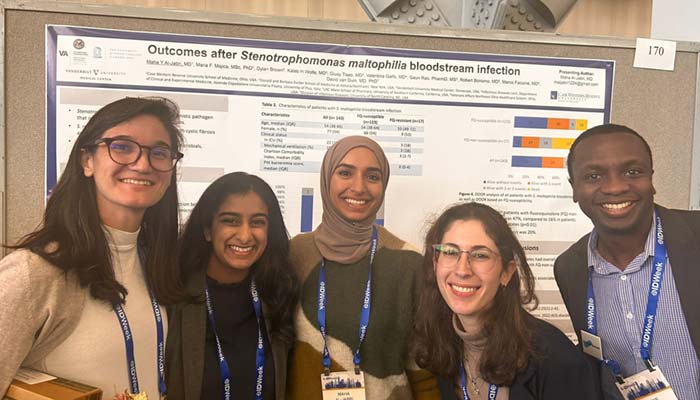
Support is provided for trainees to attend a national meeting during their fellowship. Attendance at additional meetings within their interest is encouraged, and supported financially when feasible, especially for fellows who are presenting.
Fellows often attend and present at the following conferences:
- Conference on Retroviruses and Opportunistic Infections (CROI)
- IDWeek (IDSA)
- American Society for Microbiology (ASM)
- Society for Healthcare Epidemiology of America (SHEA)
- Infectious Diseases Society of Ohio
Does the program support fellows presenting at national conferences?
Yes. The program funds attendance at a national meeting during fellowship, usually IDWeek, and provides additional financial support for fellows presenting at other conferences such as CROI, ASM meetings, SHEA, etc.
Training Sites: Three Health Systems, One Fellowship
Fellows rotate across three clinical training sites, each offering a distinct and complementary perspective on infectious disease care, all affiliated with Case Western Reserve University School of Medicine. Fellows encounter a different infectious disease population at each site: tertiary and quaternary care and transplant-associated infections at University Hospitals, veteran-focused and interprofessional care at the VA, and care of vulnerable groups of patients at MetroHealth.
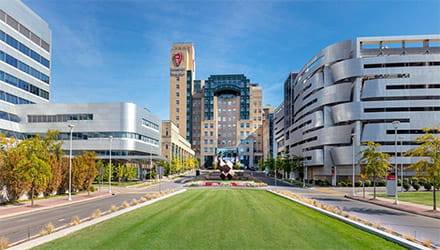
University Hospitals Cleveland Medical Center
University Hospitals Cleveland Medical Center is a 1,000+ bed academic hospital and regional referral center for a network of 20+ hospitals throughout Northeast Ohio. Here, fellows see the full breadth of infectious diseases associated with tertiary and quaternary care, including stem and solid organ transplant-associated infections, prosthetic joint and surgical device related infections, trauma, and HIV-associated infections. University Hospitals is also home to the John T. Carey Special Immunology Unit, which has pioneered clinical care and research in HIV for more than three decades, the Roe Green Center for Travel Medicine and Global Health, and the Cleveland Ohio Respiratory Viruses Vaccines Effectiveness Site (CORVETS) funded by the CDC.
Infectious Diseases Leadership in the Department of Medicine
Igho Ofotokun, MD, MSc, FIDSA, recently joined University Hospitals as Chair of the Department of Medicine and Physician-in-Chief. He also holds the STERIS Chair of Excellence in Medicine and is the John H. Hord Professor of Medicine at Case Western Reserve University. Dr. Ofotokun follows a lineage of Infectious Diseases leaders within the Department of Medicine at University Hospitals and Case Western Reserve University, including Dr. Robert A. Salata and Dr. Charles C. J. Carpenter. Dr. Ofotokun formerly worked at Emory University, holding the title of Grady Distinguished Professor of Medicine. He is a distinguished clinician, mentor, and researcher whose work addresses HIV's long-term impact on vulnerable and aging populations and long COVID, with notable global reach and impact. Among many distinctions and honors, he is a member of the National Academy of Medicine.
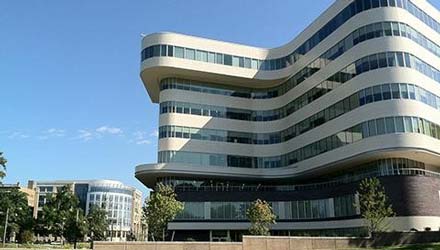
Louis Stokes Cleveland VA Medical Center
The Louis Stokes Cleveland VA Medical Center provides comprehensive care to more than 100,000 veterans. At the Cleveland VA Medical Center, fellows see "bread and butter" infectious diseases related to cardiovascular, urologic, orthopedic, oncologic and spinal cord injury conditions. It is also the site of the Infectious Diseases Patient Aligned Care Team (PACT), where fellows participate in the interprofessional care of veterans living with HIV.
Research Excellence at the VA
The Louis Stokes Cleveland VA Medical Center is one of the largest VA medical centers nationally, renowned for its high quality, dedication to education, and research programs. Historically and today, there has been a strong focus on scholarship in vaccine immunology, global health, mechanisms of antibiotic resistance, diagnostics and stewardship, and infection control, with research conducted at the Cleveland Geriatrics Research Education and Clinical Center (GRECC) and the Case Western Reserve University–Cleveland VAMC Center for Antimicrobial Resistance and Epidemiology (Case-VA CARES).

MetroHealth
MetroHealth is a major academic medical center and the public hospital of Cuyahoga County, providing care to the county's most vulnerable residents since 1837. MetroHealth has a strong partnership with its communities, a nationally recognized trauma center, and Cuyahoga county's TB clinic. Fellows see a wide breadth of infectious disease, including complications of advanced HIV and community-acquired and post-surgical infections. MetroHealth is also home to a dynamic and progressive HIV clinic, where fellows learn to care for people living with HIV, supported by social work, pharmacy and mental health specialists.
A History of Discovery in Infectious Disease
MetroHealth has a celebrated history of contributions to infectious diseases in the 20th century, marked by a Nobel Prize awarded to Dr. Frederick C. Robbins for culturing poliovirus in cells, Dr. Charles Rammelkamp’s breakthrough use of penicillin to prevent rheumatic fever, and Dr. Emmanuel Wolinsky’s pioneering work on non-tuberculous mycobacteria. To this day, it is the site of important research establishing connections among inflammation, metabolic changes, viral dynamics, polysubstance use, social drivers of health, and mental health symptoms in people living with HIV.

Case Western Reserve University School of Medicine
Case Western Reserve University School of Medicine is the intellectual glue that unites more than 30 clinical, education and research faculty across Cleveland's academic medical centers, coordinating transdisciplinary efforts that touch many infectious diseases and backgrounds. Founded in 1843, CWRU School of Medicine is one of the top 25 medical schools in the country, and both the No. 1 medical school and largest biomedical research institution in Ohio.
The Uganda-CWRU Research Collaboration
The Uganda-Case Western Reserve University Research Collaboration began in the 1980s, when Uganda's president invited Dr. Frederick C. Robbins, CWRU faculty member and Nobel laureate, to help address the HIV/AIDS epidemic. It evolved into a multidisciplinary effort at Makerere University, Mulago Hospital, and the Joint Clinical Research Center, focusing on HIV/AIDS and tuberculosis. The partnership aims to build local capacity and provide research-based training to improve healthcare, leveraging CWRU's faculty and resources from the Tuberculosis Research Unit, the Center for AIDS Research, and the AIDS Clinical Trials Unit. It spans epidemiology, biomedical sciences, clinical trials, nursing, anthropology, and bioethics, and, more recently, biomedical engineering, cancer, and cardiovascular disease.
Center for Global Health and Diseases
The Center for Global Health and Diseases at CWRU continues the legacy of one of the first Divisions of Geographic Medicine in the U.S. It connects the university's extensive international health resources, its affiliated institutions, and the Northern Ohio community into a multidisciplinary program dedicated to research, training, and clinical efforts in global health and diseases. This includes work on dengue, dracunculiasis, lymphatic filariasis, onchocerciasis, rabies, schistosomiasis, and various helminthiases.