


Research Areas
Dedicated to Understanding the Molecular Pathways of Lung Development
The Raffay Laboratory is dedicated to identifying the molecular pathways that drive lung injury and impaired lung development in premature infants and developing new therapeutic approaches to prevent or reverse disease progression. The laboratory conducts overlapping basic, translational, and clinical research focused on:
- Bronchopulmonary dysplasia (BPD)
- Premature lung development and injury
- Airway hyperreactivity and childhood asthma
- Pulmonary hypertension
- Acute lung injury
- Sepsis-associated lung disease
- Idiopathic pulmonary fibrosis
- Cystic fibrosis
- Microbiome and lung-gut axis
A particular area of interest is understanding why children born prematurely remain at increased risk for wheezing disorders and asthma long after discharge from the NICU, including those who never develop severe BPD.
From Discovery to Patient Care
The Raffay Laboratory works closely with clinical and scientific collaborators to develop and validate innovative disease models and therapeutic interventions. The team also studies physiologic and biomarker data from premature infants, including:
- Continuous pulse oximetry monitoring
- Respiratory physiology measurements
- Oxidative stress biomarkers
- Long-term respiratory outcomes
By integrating laboratory science with clinical research, the lab seeks to accelerate the development of effective treatments that improve the lives of premature infants and children with chronic lung disease.


Bronchopulmonary Dysplasia Research
Understanding and Treating Bronchopulmonary Dysplasia
Dr. Raffay is actively studying the treatment of premature infants diagnosed with bronchopulmonary dysplasia (BPD), a unique chronic lung condition that affects infants born prematurely. Oxygen therapy and positive pressure ventilation are life-saving for premature infants treated in the neonatal intensive care unit (NICU). However, it often has the consequence of leading to BPD, damaging the infant’s fragile airways and creating tissue destruction in the tiny alveoli.
The results can be devastating. In the U.S. alone, more than 10,000 new diagnoses of BPD are made annually with estimated costs exceeding $2.5 billion. Exercise limitations and obstructive airway disease often persists into adulthood, and there are approximately 1 million BPD survivors in the United States. Unfortunately, effective BPD therapies are lacking.
Identification of Gene that Plays Pivotal role in Development of BPD
Dr. Raffay’s lab has identified a gene that may play a pivotal role in the development of BPD in premature infants treated with oxygen in the NICU – especially with regard to later complications of asthma and pulmonary hypertension. Life-saving oxygen in the newborn may also cause the beneficial bronchodilator and antioxidant S-nitrosoglutathione (GSNO) to be rapidly broken down in the lungs by the catabolic enzyme GSNO reductase. Children with BPD have more of this catabolism enzyme in lung biopsies and newborns at-risk for BPD have more enzyme in their airways. His work has shown that exogenous GSNO or elimination of its catabolism gene prevents or reverses much of BPD disease in the laboratory. University Hospitals was part of the GSNO reductase inhibitor trial for cystic fibrosis and is currently studying inhaled GSNO for asthma. The hope would be these agents will soon be studied in clinical trials to treat BPD patients.
GSNO Metabolism Research
Translational Research: Targeting GSNO Metabolism
A major focus of the Raffay Laboratory is understanding the role of S-nitrosoglutathione (GSNO), a naturally occurring molecule that acts as both a bronchodilator and antioxidant in the lung. Research conducted by Dr. Raffay and collaborators has identified GSNO reductase (GSNOR), the enzyme responsible for breaking down GSNO, as a potential driver of lung injury in premature infants exposed to oxygen therapy. Studies have demonstrated that:
- Infants at risk for BPD have elevated levels of GSNOR in their airways.
- Children with BPD show increased GSNOR expression in lung tissue.
- Excessive GSNO breakdown may contribute to later complications, including asthma and pulmonary hypertension.
- Restoring GSNO levels or inhibiting GSNOR activity can prevent or reverse many features of BPD in preclinical models.
These findings have established a promising therapeutic pathway and provide the foundation for future clinical trials aimed at improving outcomes for infants with BPD.
Asthma and Airway Hyperreactivity after Preterm Birth and Bronchopulmonary Dysplasia (BPD)
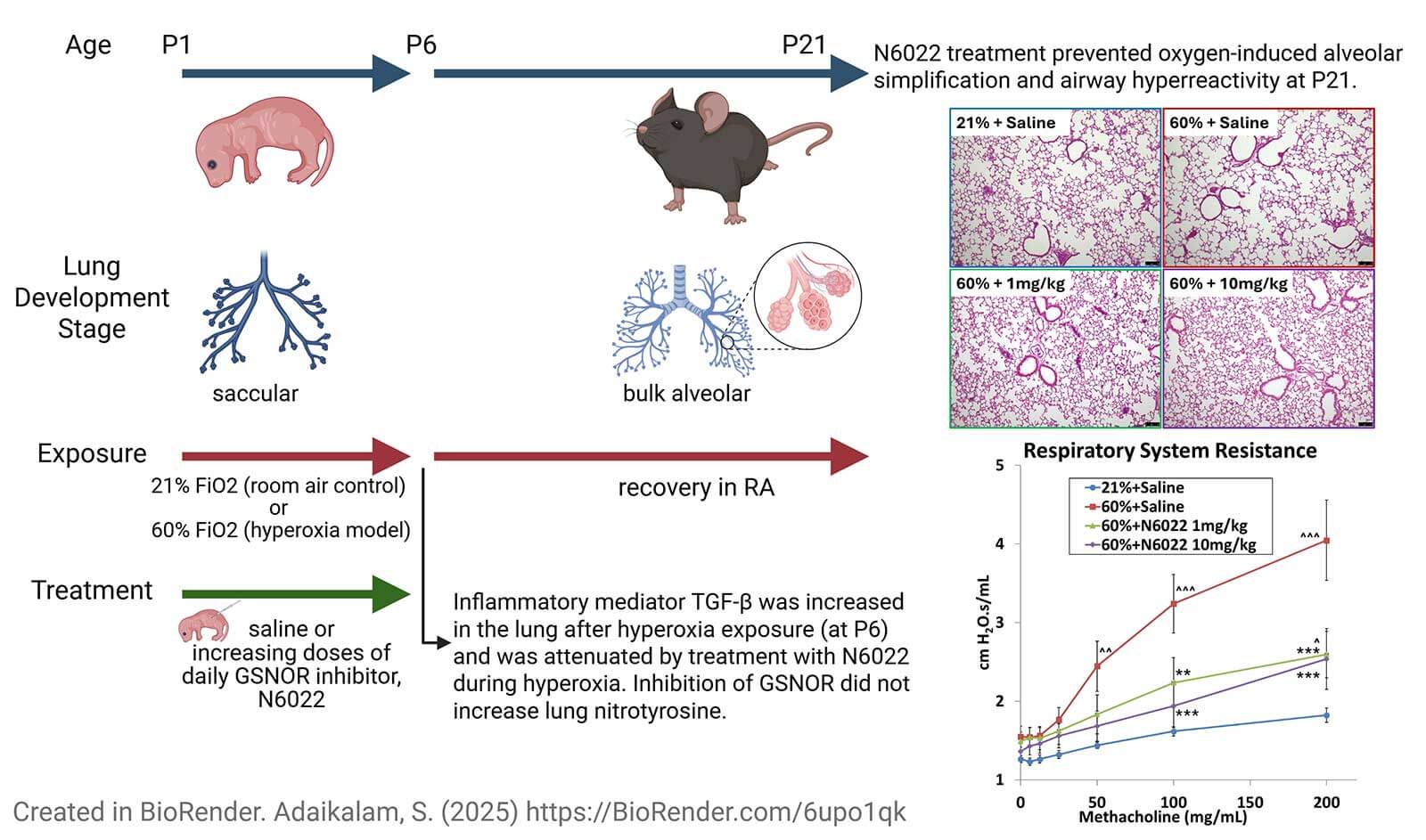
Dr. Raffay describes his research, “Wheezing disorders and asthma-like symptoms are the most common childhood pulmonary sequalae of premature birth. I have shown that by the first week of life, continuous pulse oximetry patterns, cumulative oxygen exposure, and ventilator support may be predictive of the hospital diagnosis of BPD and future asthma diagnosis requiring medication. Asthma medications are often used to treat these respiratory symptoms with variable responses. In fact, we have shown that regular treatment with a long-acting beta-adrenergic bronchodilator in BPD mice diminishes beta-receptor pools, increases sensitivity to bronchoconstriction, and blunts rescue bronchodilation. We have similarly observed variable clinical responsiveness to beta-adrenergic bronchodilators in the intensive care unit."
"S-nitrosoglutathione (GSNO) is an alternative endogenous airway bronchodilator more potent than traditional asthma medications with additional biological activity including beneficial effects on the maturation of F508Del-CFTR and activity of beta-adrenergic receptors. The reductase enzyme that breaks down GSNO is increased in BPD mice and elevated in human BPD lung specimens. Repletion of GSNO rapidly improves lung function measurements in BPD mice. Furthermore, mice that do not express the reductase gene at birth are protected from developing BPD, including severe complications such as tracheomalacia and pulmonary hypertension. We are now working to characterize delivery of GSNO and pharmacologic inhibition of its reductase enzyme to prevent BPD. Current development of S-Nitrosothiol based therapies for other lung diseases, such as asthma, idiopathic pulmonary fibrosis and cystic fibrosis, will likely benefit this high-risk population of infants and children."
Respiratory Control and Disease in the Neonate
Continuous cardiorespiratory and pulse oximetry waveform analyses reveal that the hospitalized infant experiences frequent transient decreases in oxygenation, termed intermittent hypoxemia (IH). All preterm infants have dozens of these IH events each day. Some IH events are associated with inflammatory and oxidative stress while others may be benign. What is known is that elevated hypoxemia burden is associated with increased morbidity and mortality in this high-risk patient population. We are investigating the outcomes of IH patterns and biomarkers in observational trials to better delineate pathology from normal development. The intentions are that these studies will allow for improved risk-stratification and targeted interventions in neonates.
Translational Modeling of Cardiopulmonary Disease
Novel models of cardiopulmonary disease have provided translational in vivo and in vitro platforms to investigate and test therapeutics. Dr. Raffay and his scientific collaborators have worked to establish and validate both new models and new interventions at the bench to understand and potentially improve cardiopulmonary disease at the bedside. These include the study of bronchopulmonary dysplasia, asthma, idiopathic pulmonary fibrosis, acute lung injury, pulmonary hypertension, sepsis, and cystic fibrosis. The Raffay laboratory has extensive expertise in murine models of lung biology and physiology, including in vivo small animal pulmonary function measurements, ex vivo precision-cut living lung slice preparations & culture, in vitro wire myography, and lung fixation & histology.
