


Multidisciplinary Approach Personalizes Meningioma Treatment
June 22, 2026
Innovations in Neurology & Neurosurgery | Summer 2026
 Clement Pillainayagam, MD
Neuro-Oncologist Clement Pillainayagam, MD, is serving as University Hospitals’ primary investigator for a multi-institutional Alliance for Clinical Trials in Oncology research study of meningiomas. The current arm of the National Cancer Institute-funded clinical trial is the first genomically driven phase II study evaluating the safety and efficacy of systemic therapy in patients with progressive grade 1-3 skull base meningiomas.
“We used to view all meningiomas as the same before identifying that there are genetic differences linked to the tumor’s location,” says Dr. Pillainayagam, who is neuro-oncologist at University Hospitals and an Associate Professor of Medicine at Case Western Reserve University School of Medicine. “This trial has three arms, each targeting a specific mutation found in different meningiomas and matched to pharmaceuticals developed to provide more precise treatment.”
Meningiomas are the most commonly diagnosed primary brain tumors, affecting one to three percent of the U.S. population. Although most are benign, slow-growing tumors, a subset of higher-grade meningiomas exhibits aggressive growth and recurrence, resulting in a potentially significant symptom burden, including migraines, seizures or sensory issues.
“The location of the meningioma matters because one of the mutations is more often found in skull base tumors, specifically the AKT1/PIK3CA/PTEN mutation, which is the current focus of the Alliance clinical trial,” Dr. Pillainayagam says. “Surgical removal of skull base tumors is particularly challenging because of the proximity to tiny cranial nerves and facial muscles, increasing the risk of neurological deficits.”
In the current arm of the Alliance trial, patients with the AKT1/PIK3CA/PTEN mutation are treated with an AKT inhibitor, and tumor growth is measured at six months and at subsequent intervals.
Personalized, Staged Meningioma Treatment
For asymptomatic grade 1 meningiomas, observation with regular MRIs is often the first-line standard of care. Surgical resection is the primary treatment for progressive or symptomatic tumors, and radiation is indicated for patients who are not surgical candidates or for those with residual tumors. Medication therapy may be considered for patients who experience tumor regrowth or are poor candidates for surgery or radiation.
University Hospitals also offers leading-edge oncologic technology , including specialized PET imaging and molecular sequencing. A Brain Tumor Board and a Skull Base Tumor Board, both composed of multidisciplinary experts, meet regularly to discuss challenging cases.
“Our goal is to offer patients a comprehensive approach that augments surgery and radiation. This is where clinical trials such as the one above help us; as another option besides repeat surgery and/or radiation. “Our role is to explain the options and risks to help each patient decide what’s right for them.”
DOTATATE PET Scans
DOTATATE PET scans are highly sensitive imaging tools that target somatostatin receptors to detect recurrent tumors or tumor cells. In addition to serving as a valuable tool for tracking patients after treatment, they are useful in guiding precise radiation therapy and have quickly become part of the clinical flow at large brain tumor centers like UH.
“We have an excellent nuclear medicine program at UH that enables us to utilize these innovative tools,” Dr. Pillainayagam says. “Using a radioactive amino acid, the DOTATATE scan lights up receptors in minute residual meningiomas that might not be detectable with a traditional MRI.”
The specialized scan helps distinguish tumors from scar tissue and provides a method to track potential regrowth. “Additionally, our radiation specialists are using information from the scans to plan radiation fields to guide precision treatment,” Dr. Pillainayagam says. This helps us be more precise with where radiation is given, and adds to the individualized approach to the patient, even outside of clinical trials.
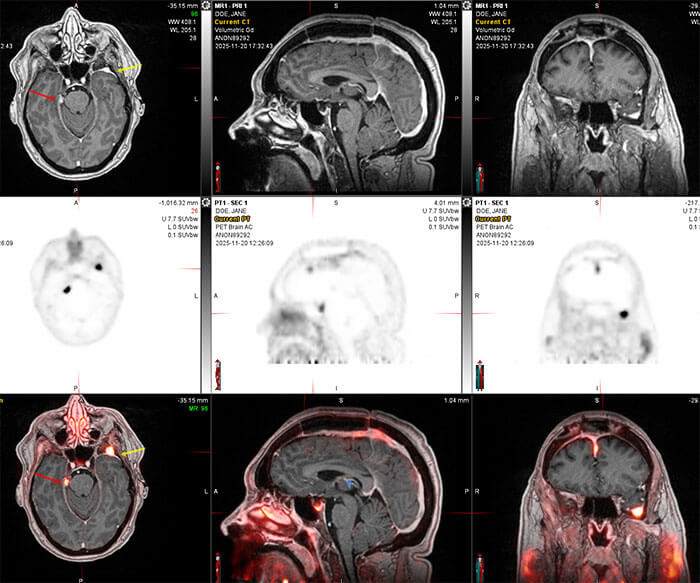 Comparison of MRI (top) and DOTATATE PET (bottom) scans.
Molecular Sequencing
Molecular sequencing of meningiomas is helping specialists at University Hospitals better predict tumor growth and identify treatment targets. Of particular interest are DNA methylation signatures for classifying tumors and predicting their risk of recurrence.
“I explain to patients that these methylations are pathways that can activate within the tumor, essentially like revving an engine by pushing on the gas pedal,” Dr. Pillainayagam says. “Knowing there are methylation patterns that have been found to have more aggressive recurrence helps us see which patients we should monitor more closely. This is being incorporated more and more in daily clinical practice.
Organoid Tumor Growth
Though targeted therapy like in the clinical trial discussed initially is an exciting start, there is further to go for better treatments.
University Hospitals’ Clinical Pathologist Tyler Miller, MD, PhD, is cultivating tissue collected during meningioma resections to support organoid tumor growth.
“By using the patient’s own tissue, he is able to successfully grow a representation of that individual’s tumor,” Dr. Pillainayagam says. “The goal is to one day be able to test these against a library of drugs that might prove effective. This innovative research is hoped one day to be at the forefront of future personalized meningioma treatment.”
Continued Innovation
Tracking meningiomas and identifying their genetic differences is essential to caring for patients who experience long-term effects of tumors that can continue to grow and recur for many years.
“At the end of the day, this work is about minimizing the side effects of meningiomas while maximizing clinical benefits for these patients so that we can continue to improve their quality of life,” Dr. Pillainayagam says. “While there is no single right answer, the comprehensive, collaborative approach here at UH helps us continue to have conversations that address all of our options and provide each patient with a personalized approach to their care.”
To refer a patient to University Hospitals or learn more about meningioma clinical trials, call 216-983-3021.
Contributing Expert:: Clement Pillainayagam, MD