


Catheter Ablation for the Treatment of Atrial Fibrillation
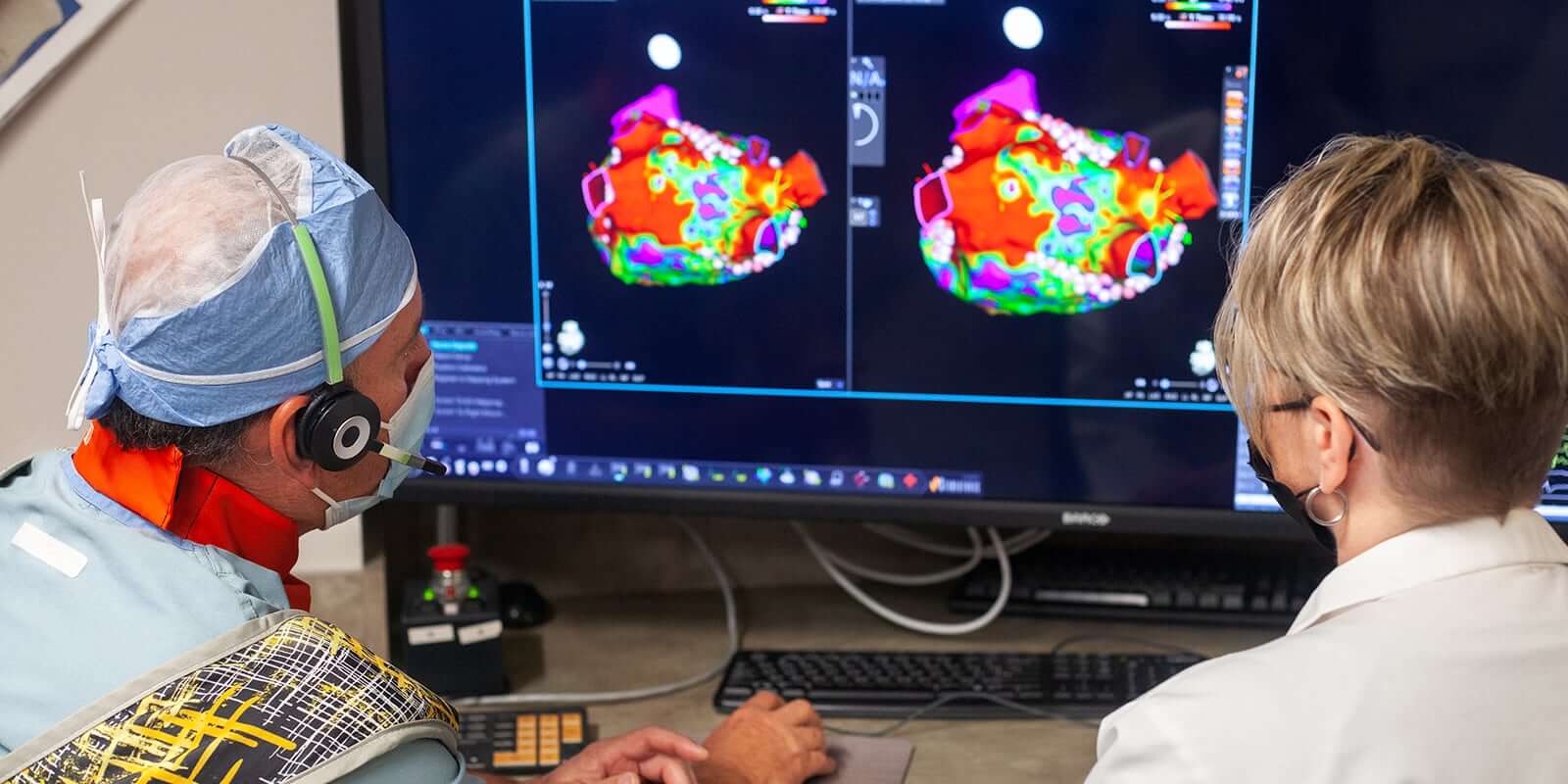
Catheter ablation is a minimally invasive procedure that uses targeted energy to correct the abnormal heart rhythms of atrial fibrillation (AFib). By destroying small areas of tissue in the heart responsible for irregular electrical signals, catheter ablation can restore a normal heart rhythm for many patients, reducing symptoms and the need for lifelong medication.

Make an Appointment
Call 216-844-3800 to schedule an appointment with a UH atrial fibrillation specialist today.
Quick Facts
- What It Is: A minimally invasive procedure that uses heat, cold or electrical pulse energy delivered through a thin catheter to treat atrial fibrillation by restoring normal heart rhythm.
- Who It’s For: Adults with AFib who have persistent symptoms despite medication or wish to avoid long-term drug therapy.
- Success Rate: 80 – 90% for many patients with paroxysmal (intermittent) AFib; high success for other types depending on individual factors.
- How It’s Done: Performed with a heart catheter, the procedure is not considered a surgery. It does not require cuts or stitches.
- Recovery: Most patients return home the same day and are back to typical activities within one week, with full rhythm stabilization in 2 – 3 months.
- UH Advantage: Decades of experience, nationally recognized team, advanced safety technology and outcomes that equal or exceed leading U.S. centers.
How Does Catheter Ablation Work?
Catheter ablation delivers energy through a catheter (a thin flexible tube) to the small areas in the atria (upper chambers of the heart) that cause AFib. The energy destroys (ablates) these areas, creating tiny scars to break up and block abnormal electrical signals, restoring the normal heart rhythm.
The two main types of catheter ablation used at University Hospitals are:
- Radiofrequency ablation (RFA): Uses heat to destroy the tissue that triggers the AFib.
- Pulsed field ablation (PFA): Uses high-voltage electrical pulses to create small holes in the cell membranes of the tissue that triggers the AFib.
Another ablation technique, called cryoablation (CA), uses extremely cold gas to freeze and destroy the abnormal heart tissue. However, this method is used far less frequently than RFA and PFA.
Differences Between RFA and PFA
Each catheter ablation method has potential advantages and disadvantages. Your heart rhythm specialist (electrophysiologist) will discuss which procedure is best for you based on your condition, any previous AFib treatments you’ve had and your overall health.
All catheter ablation procedures are minimally invasive procedures, with faster recovery times and fewer complications when compared to open-heart procedures. Key differences between RFA and PFA include:
Radiofrequency Ablation (RFA)
- Delivers beams of heat energy to the affected area of the heart and creates scar tissue in the area.
- A well-established procedure with decades of successful use.
Pulsed Field Ablation (PFA)
- Delivers short beams of high energy to the affected area of the heart and creates holes in the cells.
- A newer, emerging technique that has shown a strong safety profile.
- Much more selective to heart muscle, which reduces the risk of damaging nearby tissues.
- Shorter procedure times.
- Lowers risk of complications such as damage to the esophagus and phrenic nerve.
- Comparable or better long-term outcomes at one year.
Because PFA has a lower risk of complications and shorter procedure times, it’s often recommended for older patients and patients with other serious medical problems.
What Happens During a Catheter Ablation Procedure?
Catheters are inserted into blood vessels (at the right side of the groin) and guided to different locations in the heart under X-ray or intracardiac echo guidance. The catheters record and map the arrhythmia (abnormal heart rhythm) to identify the areas in the atria (upper chambers of the heart) where the abnormal electrical activity is occurring. One of the catheters has a larger tip and is used to deliver the ablation energy to the target sites.
Throughout the catheter ablation, you will be monitored in many ways to assess vital signs, heart rhythm, your body’s response to anesthesia and any arrhythmias. Before you wake up at the end of the procedure, all catheters will be removed, and groin vessels will be sealed with a collagen injection or a tiny stich under the skin.
After the AFib ablation procedure, you’ll be transferred to an observation area for two to three hours. Most patients go home the same day after their catheter ablation. Some patients stay overnight for monitoring, depending on their specific condition and at their doctor’s discretion. You’ll be given a detailed follow-up plan when you’re discharged.
The ablated areas will completely heal in two to three months after your procedure.

Who is Eligible for Catheter Ablation?
Catheter ablation is recommended for patients with AFib who have not achieved symptom control with medication or who experience side effects. Young, healthy patients and patients with heart failure or reduced heart function are also considered strong candidates. Published data show ablation success rates of 80 – 90% for paroxysmal (intermittent) AFib, with similar results for other patient groups when advanced techniques are used at UH.
- Patients diagnosed with paroxysmal (intermittent), persistent or long-standing persistent AFib who have symptoms despite trying rate or rhythm control medications.
- Individuals experiencing side effects or complications from anti-arrhythmic drug therapy.
- Patients with AFib and existing heart failure or weakened heart function, where ablation is known to improve symptoms and outcomes.
- Candidates who have not responded to electrical cardioversion or who want to avoid dependence on long-term medication.
- Active lifestyle AFib patients and those seeking to eliminate/reduce long-term blood thinner or heart rhythm drug dependence, after consultation with their electrophysiologist.
- AFib patients without significant, uncontrolled bleeding disorders or major comorbidities (final eligibility determined after a full evaluation).
Your UH care team will review your overall health, condition severity and prior treatments to determine if catheter ablation is your best option.
Benefits & Unique UH Expertise
Ablation has the potential to cure AFib by helping to restore normal heart rhythm and, for many patients, eliminates the need for blood thinners and other long-term medications. Our long-term ablation results equal or surpass the expected procedural success rates of other highly experienced centers worldwide.
- Why Choose UH for Catheter Ablation?
-
- The University Hospitals Atrial Fibrillation Ablation Center of Excellence+ offers a comprehensive range of AFib ablation services, including evaluation, treatment, post-procedure aftercare and associated services.
- Our board-certified and fellowship-trained electrophysiologists have been involved with both the development and clinical delivery of catheter ablation techniques for more than 30 years.
- We utilize the latest and most effective catheter ablation technologies, including the FARAPULSE PFA system – the latest generation in highly evidence-backed PFA systems. The FARAPULSE system has been used to treat AFib in over 500,000 patients with a high degree of effectiveness and safety.
- UH Harrington Heart & Vascular Institute was among the first U.S. centers to use advanced, low-radiation ablation mapping, making the procedure safer and more comfortable for patients.
- UH Harrington Heart & Vascular Institute actively participates in clinical research for the development and improvement of catheter ablation techniques. For example, we were a participating site in the CASTLE-AF multi-center trial, which found that catheter ablation in heart failure patients with AFib reduces mortality and hospitalization due to heart failure.
- The medical industry seeks out our UH Atrial Fibrillation Ablation Center of Excellence+ to perform FDA clinical trials for new technologies and initial evaluation of approved catheters and mapping systems before they are released to market.
- We are currently investigating the use of catheters capable of delivering both radiofrequency and PFA ablation. We have also pioneered other PFA technologies that utilize different catheter designs.
- The advanced technologies we employ include ablation by robotic cardiac surgery for patients with complex heart anatomies that are unsuitable for conventional manual catheters.
- We have been selected as a training center for performing concomitant AFib ablation and the Watchman implant in the same procedure.
When Is Catheter Ablation Preferred Over Other AFib Treatment Options?
- Catheter ablation is typically indicated when anti-arrhythmic and heart rate control medications fail to improve a patient’s AFib symptoms or when a patient can’t tolerate the side effects of anti-arrhythmic medications, heart rate control medications and/or blood thinners.
- Catheter ablation may be considered even before attempting anti-arrhythmic medications for younger patients and patients with heart failure.
- Catheter ablation is often the first-line, nonsurgical minimally invasive treatment for AFib and may be preferred over more invasive surgical procedures.
- Situations where surgical AF ablation may be recommended include:
- When ablation can be done at the same time as other needed heart surgeries, such as coronary bypass or heart valve surgeries.
- Selective challenging cases where previous catheter ablations have failed.
- Some patients with long-standing persistent AFib may benefit from the convergent procedure, in which the cardiac surgeon and electrophysiologist work as a team to combine minimally invasive video assisted (VATS) ablation with catheter ablation techniques.
What to Expect After Your Ablation Procedure
Most patients return home the same day and can resume light activities within 1 week. Heavy lifting should be avoided for 10 – 14 days. Occasional palpitations or mild chest discomfort are common during the first 2 months as the heart heals. Follow-up visits or testing is scheduled at 1 and 3 months post-procedure, if not earlier.
Recovery Timeline
Immediate and Short-Term Recovery (1 – 2 Weeks)
- Hospital Stay: You’ll spend a few hours in recovery following your ablation. Depending on your condition, you may go home the same day or spend a night at the hospital.
- Activity: Walk the evening of the procedure. Light activity at home is okay. Avoid driving for 1 to 2 days or until your doctor tells you it’s okay to drive. If your job does not involve heavy lifting or other physical labor, you should be able to return to work in 3-5 days; you may need more time off if you have a physically demanding job.
- Symptoms: Bruising, soreness or small lumps at the catheter sites are all normal during the first week or two and should go away in three to four weeks. Mild fatigue and chest discomfort are also normal symptoms at this time. You may also experience skipped or irregular heartbeats as your heart begins to heal. Contact your doctor’s office if you have mild symptoms that become worse.
- Restrictions: No soaking in water (baths, pools) for 7 to 10 days. Avoid strenuous exercise, heavy lifting (>10 pounds) and sex.
- Medication: Your doctor may continue or newly prescribe blood thinners to help prevent blood clots. You may have to take this medicine for several months or longer following your ablation, depending on your condition.
- Follow-up: First check-up often at 2-4 weeks to review medications and symptoms.
Full Recovery & Healing (Up to 3 – 6 Months)
- Internal Healing: Scar tissue forms, which can take up to 3 months.
- Symptoms: Arrhythmia episodes and mild fatigue may persist during this period.
- Follow-up: A follow-up appointment is usually scheduled at around 6-12 months to assess long-term success of the procedure.
Patient/Caregiver Checklist for Managing the First Week at Home
- Check catheter sites for signs of infection every day for a week. Keep site dry as instructed.
- Call your doctor or nurse advice line if you experience chest pain, shortness of breath, bleeding at the catheter sites or signs of infection at your catheter sites, which can include:
- Redness
- Swelling
- Pus drainage
- Warmth at the incision site
- Fever: a temperature of 101°F or greater
- Avoid using lotions, powder or creams on the puncture sites.
- No soaking: baths, hot tubs, swimming, etc.
- Take your medicines exactly as directed. Don’t skip doses. Be sure to go over your medicine instructions with your provider before you are discharged.
- Stick to your normal diet but eat bland foods if your stomach is upset. Drink plenty of fluids.
- Get rest and keep activity light. Avoid heavy lifting (>10 pounds), bending and stairs.
- Avoid driving for at least 2 days.
What Are the Risks Associated With Catheter Ablation?
Catheter ablation is considered a low-risk procedure. University Hospitals electrophysiologists have performed thousands of catheter ablations, regularly achieving success rates that meet or exceed national benchmarks. University Hospitals was among the first U.S. centers to do advanced mapping and ablation with no or low radiation exposure, making the procedure safer and more comfortable for patients.
Serious complications from catheter ablation are rare. However, as with any minimally invasive percutaneous procedure, there are some risks which should be considered. We advise all patients to discuss the risks and benefits of catheter ablation with their doctor before making the decision to go ahead with the procedure.
Common/Minor Risks
- Puncture Site Issues: Bruising, swelling or a lump at the site where the catheters entered the body (usually the groin).
- Arrhythmias: New or worsening irregular heartbeats (arrhythmias) or a slow heart rate (heart block).
- Pericarditis: Inflammation of the heart’s outer lining, which can cause chest pain and lead to pericardial inflammation with effusion (a buildup of fluid in the space around the heart).
- Fatigue/Dizziness: Feeling tired, lightheaded, or experiencing nausea.
Serious But Rare Complications
- Vascular Problems: Damage to blood vessels, pseudoaneurysms (weakening of an artery) or bleeding/hematoma in the abdomen.
- Blood Clots: Clots in the legs or lungs.
- Stroke: Blood clots may travel to the brain to cause stroke or temporary neurological issues.
- Pulmonary Vein Stenosis (PVS): Narrowing of the veins that connect the heart to the lungs.
- Heart Attack: Blockage of blood flow to the heart muscle.
- Phrenic Nerve Injury: Temporary or permanent diaphragm paralysis.
- Esophageal Damage: Very rare risk of an atrio-esophageal fistula (hole between heart and esophagus) that may be life threatening.
- Death: Extremely rare, but possible, often as a result of heart perforation, stroke or fistula.
Concomitant AFib Catheter Ablation With Left Atrial Appendage Closure
Concomitant AFib catheter ablation with left atrial appendage closure (LAAC), also called left atrial appendage occlusion (LAAO), is a combined procedure that treats AFib through catheter ablation and sealing off the heart’s left atrial appendage (LAA). The LAA is a small pouch of muscular tissue that connects to the left atrium (upper left heart chamber). Importantly, this procedure is performed via heart catheterization without surgery.
Sealing off the LAA prevents blood clots from forming and entering the bloodstream and traveling to the brain to cause a stroke. In people with AFib, the LAA is where more than 90 percent of stroke-causing clots form. If AFib catheter ablation is not indicated by an electrophysiologist, LAAC can be performed as a solo procedure (without concomitant catheter ablation).
Why Is It Done?
The combined approach of catheter ablation and LAAC/LAAO is ideal for AFib patients who can’t tolerate the side effects of blood thinners or take them long-term because of prior or high risk for bleeding and impaired mobility with risk of falling. It’s also used for patients who are at a higher risk of experiencing injuries at work. The combined procedure offers AFib symptom relief and reduced risk of stroke long term.
How Does It Work?
After catheter ablation is performed, a permanent device – typically the WATCHMAN™ FLX or Amplatzer Amulet – is guided into the LAA, where it is opened like an umbrella to block the opening. Over time, heart tissue grows around the device, permanently sealing the opening and preventing blood from entering, where dangerous blood clots could have formed. Recovery from concomitant catheter ablation with LAAC is typically similar to recovery from either catheter ablation or LAAC performed alone. Most patients will be able to discontinue their blood thinners three months after their AFib ablation with LAAO.
Catheter Ablation Follow-Up Testing FAQ
- When is my first follow-up appointment?
-
Your first follow-up appointment is usually scheduled for 2 – 4 weeks after your catheter ablation.
- What happens at my first follow-up appointment?
-
You’ll typically see a nurse or physician assistant, who will:
- Check your heart with an electrocardiogram (ECG), echocardiogram or other tests.
- Review your medications.
- Ask you about any new or returning symptoms.
- Check for issues like fatigue, chest pain or groin discomfort.
- Examine your catheter insertion site.
At this visit, you may also receive a surveillance monitor that you will wear to track your heart rhythm for a prescribed amount of time that will vary depending on your condition and the device.
- When is my second follow-up appointment?
-
Your second follow-up appointment is usually scheduled for three months after your ablation procedure.
- What happens at my second follow-up appointment?
-
At your second follow-up, you’ll likely see your electrophysiologist, have a physical exam, and get an electrocardiogram, echocardiogram or other heart test. In addition, if you’ve been wearing a surveillance monitor, your doctor will review the data from the device to determine how your heart has responded to treatment. Your provider may also change or stop some of your medications at this time.
Additional Common Questions
- Is catheter ablation for AFib a major surgery?
-
No. Cardiac ablation is a minimally invasive procedure performed in the cath lab that does not require a surgeon to open your chest. There are no incisions. Instead, you receive 1 – 3 needle punctures in your skin (usually in the groin or neck) that serves as the entry point for the catheter(s).
- How long does catheter ablation for AFib take?
-
The total AFib catheter ablation procedure, including general anesthesia, usually takes 90 minutes to 2 1/2 hours if using PFA or 2 1/2 hours to 3 1/2 hours if using radiofrequency ablation.
- What should I expect the day of my procedure?
-
At the hospital, you may be given a sedative to help you relax. You’ll also have an IV put in in your arm through which you’ll receive medicine and fluids. You will receive general anesthesia and will not be awake during the procedure. A local anesthetic is used to numb the skin where the catheters are inserted, usually the groin. The catheters are guided to your heart, where they then apply heat, cold or electrical pulse energy to the tissue in the top left chamber responsible for your AFib. Afterward, you'll rest in recovery, often lying flat for a few hours to let the catheter sites begin healing, before you go home or spend the night in the hospital.
- What are the most common side effects after catheter ablation?
-
The most common side effects of catheter ablation include bruising/swelling at the catheter insertion site, mild chest soreness and temporary irregular/skipped heartbeats that occur during the first few weeks after the procedure.
- How long before I feel better after catheter ablation?
-
Most people recover from the AFib symptoms, including fatigue and shortness of breath with exertion, in a few days to two weeks after catheter ablation, though some may take longer. Soreness at the catheter insertion point usually fades away within a week. As the heart heals, full recovery and symptom relief, especially from irregular/skipped heartbeats, can take several weeks to three months.
- Can I drive/exercise/travel after catheter ablation?
-
Due to the sedation given during the procedure, you must avoid driving for at least 24 to 48 hours after a catheter ablation. You should avoid heavy lifting (more than 10 pounds) and strenuous exercise for at least a week following the procedure. Light walking is encouraged during the first week. Follow your doctor’s advice on when you can fly following your catheter ablation. Most patients can fly 1 – 4 weeks after their procedure, depending on their recovery and the complexity of their condition.
- Will I still need medication after my ablation?
-
You may have to stay on a blood thinner (anticoagulant) for 2 to 3 months after the procedure to prevent blood clots. In addition, you may be placed on a heart rhythm medication (antiarrhythmic) for a few months to treat occasional irregular beats. Some patients must take a heart rhythm medication or blood thinner long-term, often at a lower dose, depending on their individual risk factors and the success of their ablation.
- What if I have an AFib episode after ablation?
-
It’s not uncommon to experience episodes of AFib, heart palpitations and/or fast heart rate after catheter ablation and other heart procedures. These episodes stop once your heart heals, usually within three months. You may be put on an antiarrhythmic drug for a few months to manage post-procedure AFib episodes.
- Are there alternatives if ablation isn’t successful?
-
Yes. If an initial catheter ablation for AFib isn't successful, treatment options include repeat catheter ablations, antiarrhythmic medications, electrical cardioversion, atrioventricular (AV) node ablation with pacemaker procedure, or surgical options such as the convergent procedure and Cox-IV Maze procedure.
Next Steps & Connecting With UH
Call 216-844-3800 to schedule an appointment with a UH atrial fibrillation specialist to find out if you’re a candidate for catheter ablation.
Related Resources
AFib Care at University Hospitals
Overview of AFib diagnosis, treatments and patient resources at University Hospitals.
AFib Treatments
Detailed guide to all available AFib therapies at University Hospitals and what to expect from each option.
Atrial Fibrillation Center of Excellence+ at University Hospitals
Meet our specialist team and learn about our national leader status in AFib care.
Catheter Ablation for AFib Article
A real patient journey through diagnosis, ablation procedure and recovery.

Choosing a Cardiac Electrophysiologist
Cardiac electrophysiologists (EPs) are cardiologists with advanced training in diagnosing and treating heart rhythm disorders like atrial fibrillation (AFib), atrial flutter and other arrythmias. University Hospitals Harrington Heart & Vascular Institute offers integrated EP, cardiology and surgery care with access to advanced treatment options.
Make an Appointment
Call 216-844-3800 to schedule an appointment with a UH atrial fibrillation specialist today.