


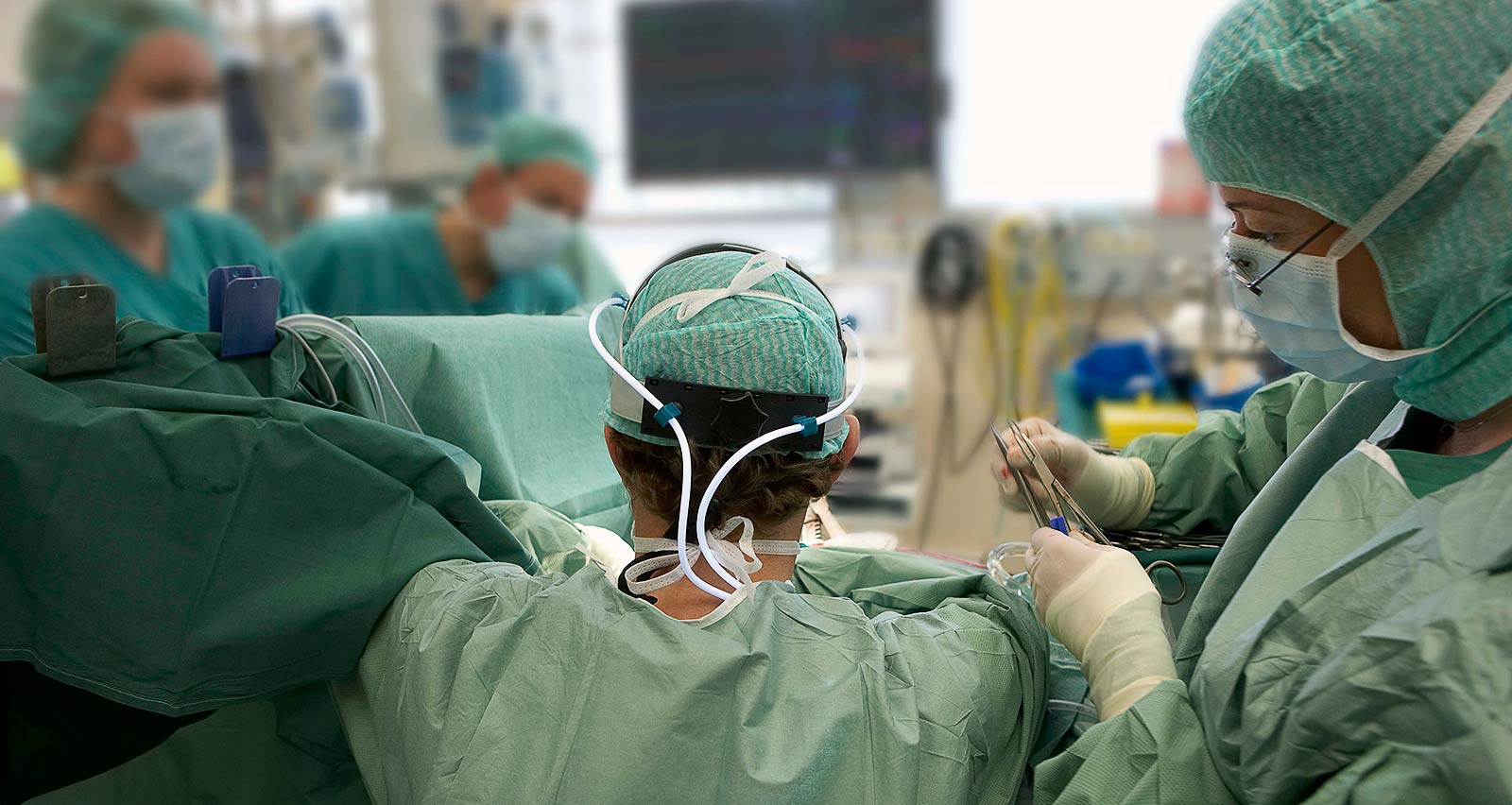
Surgery to Treat Coronary Artery Disease
Also called heart bypass surgery, coronary artery bypass grafting (CABG) is a procedure that can help improve blood flow to the heart. It involves using one or more blood vessels, usually from the arms or the chest, and connecting them to blood vessels above and below a coronary artery that is narrowed to bypass the other narrowed or blocked coronary arteries.

Call to Schedule an Appointment Today
For more information, or to schedule an appointment with one of our heart surgery specialists, call 216-844-4004.
About Coronary Artery Bypass Grafting (CABG)
Appropriate candidates for this procedure may be those who have obstructive coronary artery disease, which occurs when plaque builds up in the coronary arteries that supply the heart with oxygen-rich blood. Your heart care team will work with you to decide if CABG is right for you.
Your doctor may use diagnostic tests or procedures to determine how serious your heart disease is and where the coronary arteries are narrowed. Tests and procedures may include:
- Electrocardiogram to record the heart’s electrical activity
- Stress tests to measure how well your heart works during physical stress such as exercise or medicine given to achieve the same effect.
- Echocardiogram to assess how your heart and valves function.
- Coronary angiography to see how blood flows through your arteries. CT angiography is an alternative that uses an injection of dye in the arm along with computed tomography.
- Coronary calcium scan to get images of the calcium in the walls of your coronary arteries, which is linked to coronary artery disease.
After surgery, you will stay in the hospital for about a week, including a day or two in the intensive care unit. After you leave the hospital, you will need about six to 12 weeks to recover completely.
University Hospitals offers a number of different kinds of heart bypass surgery, including:
- Minimally invasive coronary artery bypass graft (MIDCAB)
-
Small incisions are made in the chest, and chest arteries or veins from your leg are attached to the heart to bypass the clogged coronary artery or arteries. Surgical instruments are passed through the ports to perform the procedure. Avoids need for a heart-lung machine. The procedure is performed while the heart continues to beat.
- Hybrid percutaneous coronary intervention (PCI) and coronary revascularization
-
Combines MIDCAB with percutaneous coronary intervention, a nonsurgical procedure to improve blood flow to the heart.
- Total arterial revascularization
-
All coronary arteries are provided with arterial grafts.
- Off-pump beating heart surgery
-
The operation is done with the heart beating and without the use of a heart-lung machine.
Your doctor will recommend the best type of heart bypass surgery based on your individual medical needs.
Quality Monitoring
University Hospitals is one of a few health systems that measure the flow in bypass grafts during surgery to ensure the bypasses are functional and of the highest quality. This level of quality and oversight is our commitment to excellent care and outcomes.
Frequently Asked Heart Surgery Questions
- What is coronary artery bypass grafting (CABG)?
-
This is an operation that cardiac surgeons perform to unblock somebody's arteries. When somebody has blocked arteries on their heart, they often have different options for unblocking the arteries. With CABG, our cardiac surgeons take an artery from either inside your chest, from your arm, or a vein from your leg and connect it to blood vessels above and below a coronary artery. This bypasses the blockages that are not allowing enough blood flow to go to your heart. Some of the symptoms that you may experience are shortness of breath, tightness or pain in your chest or the feeling that somebody's pushing on your chest. When you have those types of symptoms and blockages are found, you may need an operation.
- What is the success rate of a coronary artery bypass graft (CABG)?
-
Success is defined by your ability to go home healthy and resume a normal and active life. The success rate for each individual patient may be higher or lower based on the presence of other diseases such as obesity, diabetes, lung disease or kidney disease. In the U.S., the average rate of survival after coronary bypass surgery is around 98 percent.
- Why can't my arteries be fixed with a stent or a balloon?
-
When patients come for coronary bypass surgery it's usually because stents are not feasible or are not the right thing to do. Usually when you're sent to a surgeon it's because you have too many blockages to stent, the blockages are too calcified, or they're in an area where they're splitting into two different directions, which makes it difficult to use a stent. It’s important to discuss your options with your cardiologist and your heart surgeon to help decide which procedure is right for you.
- Does coronary bypass surgery ever need to be redone?
-
Very few patients who undergo coronary bypass surgery will ever need to have it done again. The data show that less than 5 percent of patients who have coronary bypass surgery are going to need another open-heart surgery. The chances of you ever needing another heart operation are probably less than one in 20, especially as technology advances and we develop better techniques for fixing your heart.
Make an Appointment
Offering in-person and virtual visits. Call today to see which option is right for you. Call 216-278-7203 or
Schedule online with a cardiologist