


Sleep Medicine Research History
1973: Development of Early Continuous Positive Airway Pressure (CPAP) Technology
John Kattwinkel, MD, Avroy Fanaroff, MD, and Marshall Klaus, MD developed silicone nasal prongs for the application of continuous positive airway pressure in treating respiratory distress in pre-term and near-term neonates.
1978: Kingman Strohl, MD, publishes the first description of familial aggregation of sleep apnea.
Research led by Kingman P. Strohl and colleagues demonstrated that obstructive sleep apnea can cluster within families, helping establish the foundation for future research into the genetic and hereditary factors that contribute to sleep-disordered breathing.
1999: Development of the Berlin Questionnaire for Sleep Apnea Risk Assessment.
Kingman P. Strohl was part of the team that developed the Berlin Questionnaire, a screening tool used worldwide to identify individuals at high risk for obstructive sleep apnea. The questionnaire remains one of the most widely recognized sleep apnea screening instruments.
2014: Research Helps Advance FDA-Approved Neurostimulation Therapy for Sleep Apnea.
Decades of research involving upper-airway stimulation and hypoglossal nerve stimulation contributed to the development of the Inspire® system, an implantable therapy for obstructive sleep apnea that received FDA approval in 2014. Kingman P. Strohl was a senior author of the landmark STAR clinical trial that helped establish the therapy's effectiveness.
A Medical Innovator and Leading Clinician in the Diagnosis and Treatment of Sleep Apnea
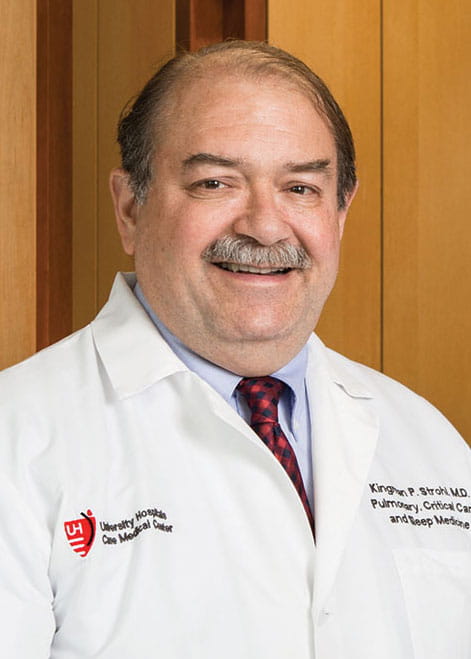
Kingman Strohl, MD
Kingman Strohl, MD has helped shape the modern understanding of sleep apnea through decades of pioneering research, clinical innovation and leadership in sleep medicine. His work was among the first to demonstrate the familial aggregation of sleep apnea, advancing the field's understanding of genetic risk. He also contributed to the development of the internationally recognized Berlin Questionnaire, a widely used screening tool for obstructive sleep apnea, and played a key role in research that led to the FDA approval of hypoglossal nerve stimulation therapy for sleep apnea. Through his scientific contributions and mentorship, Dr. Strohl has influenced generations of researchers and clinicians while helping drive advances in the diagnosis and treatment of sleep-disordered breathing.