
University Hospitals Hosts Airway Course for Pulmonology Fellows
March 31, 2026
Innovations in Pulmonology, Critical Care & Sleep Medicine | Spring 2026
On February 27, 2026, the University Hospitals Division of Pulmonary, Critical Care and Sleep Medicine presented Airway Ops: Biopsies, Frozen, and Foreign Bodies, a CME-credit pulmonary airway course and cadaver lab.
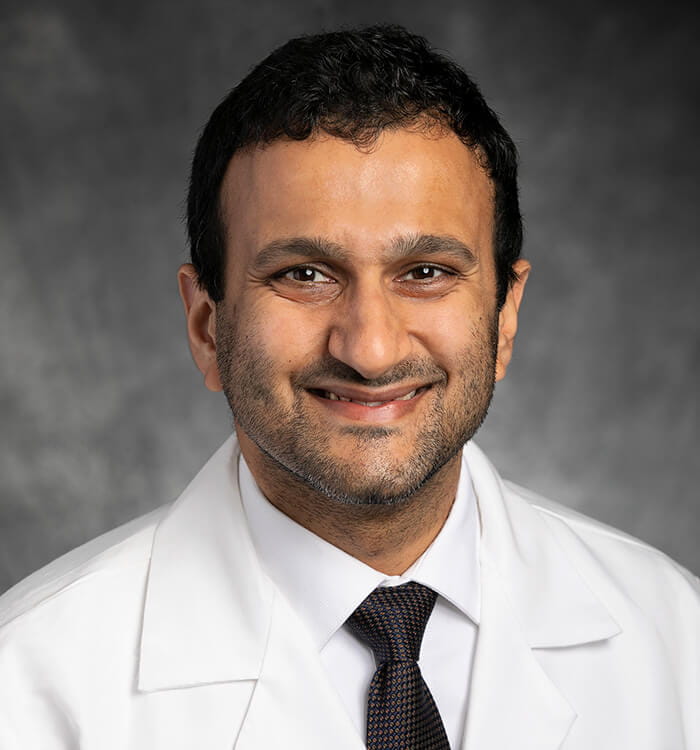 Sameer Avasarala, MD
The one-day event, a partnership between University Hospitals Cleveland Medical Center and Case Western Reserve University School of Medicine, featured guest speakers from the Mayo Clinic and the Cleveland Clinic.
“I am grateful for the support our Division has given me, first for recognizing the need for a course like this when I presented the concept in 2023, and then for enabling it to continue evolving,” says Sameer Avasarala, MD, an interventional pulmonologist at University Hospitals and an Assistant Professor at Case Western Reserve University School of Medicine. “For the last two iterations, we have been able to extend our simulation capabilities to high-fidelity cadaver-based simulation at Case Western Reserve University’s Surgical Training and Research Lab, run by Dr. Steve Schomisch, which underscores the academic collaboration between our institutions.”
Airway Course Faculty
In its fourth year, the course is led by Dr. Avasarala. “We focus on what we call bronchoscopic ‘high-acuity, low-occurrence,’ or HALO, procedures that are useful for our fellows,” Dr. Avasarala says. “These skills are essential because they must be executed promptly to potentially save a patient’s life, yet they do not occur on a day-to-day basis during training.”
University Hospitals Pulmonology Critical Care Specialist Amrita John, MD, welcomed guests with opening remarks and the introduction of esteemed guests.
“The faculty lineup reflected the best of academic collaboration,” Dr. Avasarala says. “The course’s goal is simple — to elevate safety, consistency and confidence in bronchoscopy practice among our participants.”
Darlene Nelson, MD, M.H.P.E., FCCP, Program Director of the Pulmonary and Critical Care Fellowship and Assistant Professor of Medicine at the Mayo Clinic, presented on Transbronchial Biopsies and Management of Subsequent Hemoptysis with Bronchial Blocker.
Grant Senyei, MD, MBA, an Interventional Pulmonologist at Cleveland Clinic, presented on Bronchoscopic Removal of Airway Foreign Bodies.
Dr. Avasarala spoke on Cryoprobe Utilization. Cryoprobe is a minimally invasive interventional bronchoscopy technique that uses extreme cold to obtain tissue samples or remove tumors or other foreign bodies obstructing the central airway.
“The cryoprobe is one of the tools we use frequently in bronchoscopy,” Dr. Avasarala says. “Although it has been around for 10 to 15 years, it is finding new applications as advancements have significantly reduced the probe’s size, from over two millimeters to close to a millimeter in diameter. My hope is that course participants will gain a foundational understanding of how the cryoprobe works in the morning and be able to experience using the device during the afternoon cadaver course.”
National Leadership in Airway Simulation Courses
For the past several years, Dr. Avasarala has served as Co-Chair of the American Association for Bronchology and Interventional Pulmonology’s twice-annual simulation course. He recently returned from the 2026 Mid-Year Advanced Bronchoscopy and Thoracoscopy Course in Houston.
“Every interventional pulmonology fellow across the country attends the simulation-based course,” Dr. Avasarala says. “I have been fortunate to apply much of what I have learned over the past three years as an AABIP faculty member for the course at University Hospitals so that we are able to engage participants in a meaningful manner.”
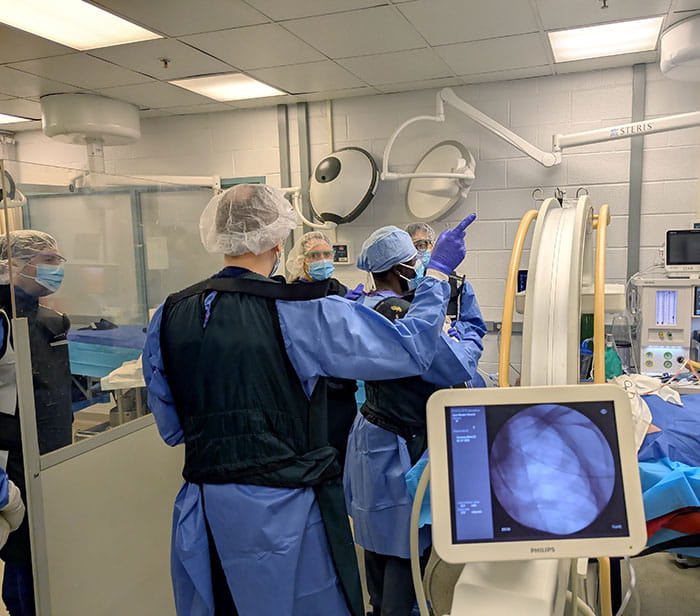 High-fidelity human cadaver-based simulation is used to train pulmonary and critical care medicine fellows fluoroscopically guided transbronchial biopsy. Additionally, equipment has been set up to simulate hemoptysis with subsequent bronchial blocker placement for management.
University Hospitals Airway Course Structure
The airway course is structured into two parts: the morning session is open to in-person and virtual registrants, and the afternoon session is limited to 15 participants in the cadaver lab.
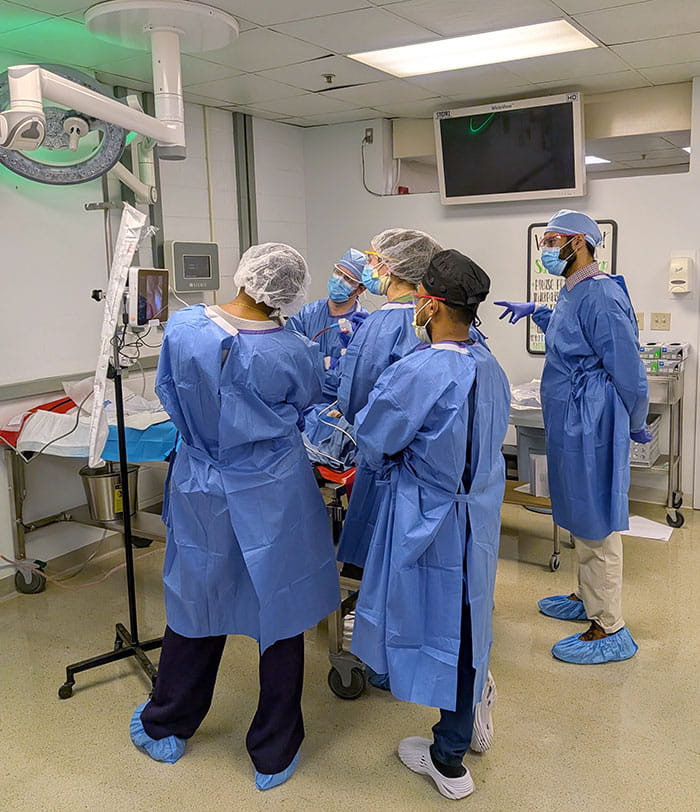 Pulmonary and critical care fellows practice airway foreign body removal in a human cadaveric model using a variety of tools via flexible bronchoscopy.
“The course is designed as a procedural playbook, with evidence-based lectures in the morning and high-fidelity cadaver training in the afternoon,” Dr. Avasarala says. “We intentionally enroll 15 participants because we have three cadaver stations, each with a faculty member present. We have found that the five-to-one ratio is optimal because everyone has a chance for deliberate practice and to ask questions and receive feedback from our faculty.”
In addition to offering the course to University Hospitals’ pulmonary critical care fellows, an invitation is extended at no cost to regionally based pulmonary critical care fellows at Cleveland Clinic, MetroHealth and Summa Health.
“The airway course underscores our UH Mission: ‘To Heal. To Teach. To Discover.’ and emphasizes our commitment to teaching as we work to enrich pulmonary critical care programs throughout Northeast Ohio,” Dr. Avasarala says. “Our goal is to offer a strategic, forward-looking model for procedural training that prioritizes real-world clinical experience.”